Showing posts with label williams sonoma. Show all posts

Tuesday, 6 July 2010

apple baby dutch


This fantastic breakfast recipe changed my opinion about cooked apples.

It’s hard to believe, but until I tasted this I’d never enjoyed cooked apples. Not apple pie, not baked apples, not apple crumble. No cooked apple.

But now I’m a changed woman.

Perhaps it’s because dutch babies are baked German pancakes introduced to the US by German immigrants to Pennsylvania, from whom I am a descended.


The strange thing about the Dutch Baby, and about the Pennsylvania Dutch in general is that they are actually Germans, confused by an English corruption of the German word deutsch.

In fact, it just occurred to me while writing this, that my brother and I are the very first generation not to be born in Pennsylvania in a direct line of descendants from a German immigrant who fought for his new country’s freedom in the American War of Independence.

Way to bring an end to some 250 years of tradition!

But back to those delicious apples, they are perfect atop this fluffy pancake that puffs up wonderfully in the oven.


Apple Dutch Baby
Adapted from a recipe on the Williams Sonoma website. Serves 4.
Ingredients:
Apple Topping
2 apples, peeled, cored & thinly sliced
1 tablespoon butter
1 teaspoon cinnamon
2 tablespoons brown sugar
Pancake
5 tablespoons butter, chopped
¾ cup all-purpose flour
3 eggs
¾ cup buttermilk
½ teaspoon salt
1 tablespoon sugar
Cream, for serving
Method:
1. Adjust the oven rack to the upper third of the oven. Turn on the oven to 200°C.
2. Put the butter in a very large (12-inch) skillet with an ovenproof handle.
3. Set in the oven for 5 minutes to melt the butter completely (okay if it begins to brown).
4. While the butter melts, measure the flour into a large bowl. Add the eggs, milk and salt. Beat until smooth, using a whisk, large spoon or handheld electric mixer.
5. Pour the batter into the hot pan. Return the pan to the oven and bake for 15 to 20 minutes, until the sides are puffed up and dark golden brown.
6. Meanwhile, to make topping, heat butter in a frying pan. Add apples, cinnamon and sugar and sauté for 8 minutes until softened. Set aside but keep warm.
7. Remove from the oven. Loosen the Dutch baby from the sides and bottom of the skillet, then slide it onto a serving plate.
8. Pile the fruit in the centre and sprinkle with powdered sugar.
9. To serve, cut into wedges and serve with thickened cream.
Note: original recipe used regular milk, was served with fresh fruit and maple syrup.


Apples are my theme ingredient for Weekend Herb Blogging.

Originating in Central Asia, the apple has more than 7,500 cultivars and is one of most widely cultivated tree fruits in the world. Heck, isn’t it the reason we’re all out here in the cold instead of kicking it back in the Garden of Eden?

Check out the WHB round-up from host Cinzia at Cindystar.

Thursday, 22 November 2007

thanksgiving pumpkin pie


As part of my Thanksgiving lunch I cooked, for the first time, a pumpkin pie.

I tried to replicate the flavour of my grandmother’s pies and I remember her telling me that her best pies always came from canned pumpkin purée. She said she used to make her own pumpkin purée from scratch but after years of doing this she discovered she preferred canned purée.

Since Australia doesn’t celebrate Thanksgiving, and since Pumpkin Pie is something quintessentially American, you can’t find canned pumpkin purée here. And yet I magically discovered two cans in David Jones’ food hall and was over the moon!

I decided to go with a Williams Sonoma recipe and was very pleased with the results. The pie had a perfect velvety texture and a gorgeous spiciness, the crust enriched with pecans.

As my first attempt at Pumpkin Pie, I was proud as punch.


Candied Pecans

Recipe by Williams Sonoma.

Ingredients:
1/3 cup superfine sugar
1 teaspoon ground cinnamon
¼ teaspoon freshly grated nutmeg
2 cups pecan halves

Method:
1. Preheat an oven to 350ºF. Lightly oil a rimmed baking sheet.
2. Over a plate, sift together the superfine sugar, cinnamon and nutmeg.
3. Place the pecans in a colander and rinse under cold running water. Shake the colander to remove the excess water.
4. Toss the pecans in the sugar mixture, coating them evenly.
5. Spread the nuts out on the prepared baking sheet in a single layer, separating any that are touching.
6. Bake the nuts until they are dry and the sugar has crystallized, about 25 minutes. Remove from the oven and let cool completely. Store in an airtight container at room temperature for up to 2 days.


Pumpkin Pie w Candied Pecans

Recipe by Williams Sonoma. Serves 8-10.
 

Ingredients:
For the crust:
1 cup candied pecans
1 cup fine cookie crumbs
155g unsalted butter, melted
For the filling:
1 can (15 oz.) pumpkin puree
3 eggs, lightly beaten
¾ cup heavy cream
2/3 cup firmly packed dark brown sugar
1 tablespoon cornstarch (cornflour)
1 tsp ground cinnamon
1 teaspoon ground ginger
¼ teaspoon freshly grated nutmeg
¼ teaspoon ground cloves
1 teaspoon vanilla extract
Vanilla ice cream for serving

Method:
To make the crust:
1. Preheat an oven to 325ºF.
2. Place 1 cup of the candied pecans in a food processor and process until finely ground.
3. Pour into a bowl and stir in the cookie crumbs and butter until all the ingredients are evenly moistened.
4. Pour into a 9-inch pie dish and, using your fingers, press the mixture to cover the bottom and sides of the dish evenly. Set aside.
To make the filling:
1. In a large bowl, whisk together the pumpkin puree, eggs, cream, brown sugar, cornstarch, cinnamon, ginger, nutmeg, cloves and vanilla extract until well combined.
2. Pour the mixture into the prepared crust and smooth the top.
3. Bake until a toothpick or thin skewer inserted into the center of the pie comes out clean, 50 to 60 minutes.
4. Transfer to a wire rack and let cool completely.
5. Just before serving, garnish the edge of the pie with some of the remaining candied pecan halves.

I'm going to submit this recipe to my own Festive Food Fair. If you want to know more about this food event, check out how to join.

Happy Thanksgiving to everyone!


Tags:

Wednesday, 10 January 2007

roquefort popovers


This is a recipe that I cooked when it was winter and cold in Sydney. These days this recipe isn’t much use for those of us in the sweltering southern hemisphere, but – for all my friends up north – this is a fantastic accompaniment to brunch, afternoon tea or a delicious soup.

Blue cheese reminds me of two people in my life: my sister Amy, who starting eating blue cheese at age seven, and my sister-in-law-to-be, Helena, who always seemed to be inventing new ways to eat blue cheese.

Of course there are many kinds of blue cheese, but both Amy and Helena are addicted, regardless of the origin or production style. Blue, blue, blue all the way!

These particular popovers are like delicious savoury muffins and the herbs and cheese in the recipe add an extra special bite.

But be warned, popovers certainly aren’t diet food!


Roquefort Popovers

Recipe from the William-Sonoma website. Makes 24.

Ingredients:
1 cup plain flour
½ teaspoon salt
¼ teaspoon freshly ground white pepper
1 tablespoon fresh flat-leaf parsley, finely chopped
1 tablespoon fresh chives, finely chopped
1¼ cups milk, at room temperature
2 eggs, at room temperature
1 tablespoon unsalted butter, melted
85g (3 oz) Roquefort, crumbled

Method:
1. Position a rack in the lower third of an oven and preheat to 230’C (450’F). Generously brush one 24-cup or two 12-cup mini-muffin pans with vegetable oil.
2. In a large bowl, whisk together the flour, salt, white pepper, chives and parsley.
3. In a large measuring cup, whisk together the milk, eggs and butter.
4. Pour the wet ingredients over the dry ingredients and whisk together until just combined (don’t worry if a few lumps remain).
5. Pour the batter into the prepared muffin cups to within about ¼ inch of the rim (about 1½ tablespoons each).
6. Place a scant 1 teaspoon crumbled cheese in the centre of each filled cup.
7. Bake for 10 minutes. Do not open the oven door during this time. Reduce the oven temperature to 180’C (350’F) and continue to bake until the popovers are brown and crusty and fully puffed, 8 to 10 minutes more.
8. Remove from the oven and immediately transfer the popovers to a napkin-lined bowl or warmed platter. Serve immediately.


Tags:

Monday, 30 October 2006

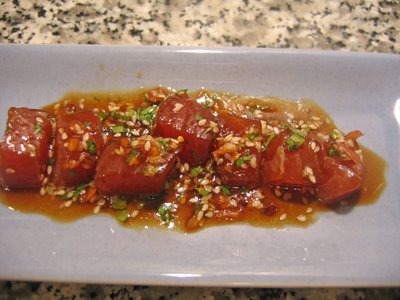
ahi poke

Ahi is the Hawaiian word for tuna and this marinated seafood dish comes from Hawaii’s Japanese population who have been in the islands for over 100 years.

Ahi Poke is available all over Hawaii in restaurants and sushi bars and is even sold, pre-made, in supermarkets.

I first tried ahi poke on a visit to Hawaii in 2004 and was pleasantly surprised by the modern take on traditional Japanese sashimi, as well as the successful addition of coriander and the sweet nutty sesame seeds.

This recipe is quick and easy so all you'll need is fresh tuna and a healthy appetite.

Ahi Poke
Recipe from Williams-Sonoma cookbook “Savouring America”. Serves 6.
Ingredients:
500g sashimi-grade tuna steaks, skin & bones removed
½ cup finely chopped sweet onion
3 tablespoons soy sauce
2 tablespoons finely chopped fresh coriander
2 teaspoons sesame seeds, toasted
Few dashes of sesame oil
Large pinch of coarse sea salt
Pinch of red chilli flakes
Coriander leaves for garnish
Method:
1. Using a sharp knife, cut the tuna into small 2cm by 2cm cubes.
2. Place tuna in a bowl and add all other ingredients.
3. Toss the mixture gently to blend evenly. Cover the bowl and refrigerate until well chilled, about 1 hour.
4. Serve garnished with coriander leaves.
Notes: Ahi poke is best eaten within a few hours of being made, but can be kept in the refrigerator for one day. Hawaiians use Maui onion, but for those of us outside the US, any sweet onion will substitute. Yellow-fin tuna is best for this recipe, although any other sashimi-grade is fine.

" Open Sesame"

Sesame is a plant widely cultivated for its deliciously nutritious seeds which contain high levels of copper, manganese, tryptophan, calcium magnesium, iron, phosphorous, zinc, vitamin B1, and dietary fibre.

In countries without oil groves, sesame oil is an important cooking oil. In fact sesame seeds are extremely rich in oil - an estimated 50% of the seed.

The origin of sesame is unknown, but studies show its closest cousins growing in Africa. The first records of cultivation come from 2000 BCE in Assyria and Babylon (modern day Iraq and Syria). It later spread throughout the Middle East and Asia.

The etymological root of the English word sesame shows its path through world cuisines. The Latin sesamum came from the Greek sēsámon which had fashioned itself after the Aramaic shūmshĕmā. This was a derivative of Babylonian shawash-shammu via Assyrian shamash-shammū. What amazes me more than anything is how close the English word remains to the original Assyrian source despite geographical distance and thousands of years.

Around 4000 years ago in China, records show sesame seed was burnt to create soot for making ink. In Ancient Greece, soldiers carried sesame seeds as emergency rations and in India, sesame is a good luck omen for Brahmins who use it as anointing oil.

It is said that The Arabian Night’s tale used “open sesame” as the magic access to the thieves den because the sound of a sesame seed being released from its pod is similar to a lock opening.

In the Middle East sesame seeds are used to make a nut paste (tahini) and a dessert (helva). In Syria and Lebanon it’s an important ingredient in a spice dip (zatar) and sesame seeds crown Turkey’s favourite snack food (simit). In Greece sesame seeds are set into slices sweetened with honey (pasteli) and they are also widely used in Indian, Korean and Japanese cuisine as a garnish and flavouring. In Europe, seeds are sprinkled over cakes and breads as decoration.

References:
http://en.wikipedia.org/wiki/Sesame
http://www.whfoods.com/genpage.php?tname=foodspice&dbid=84
http://www.theepicentre.com/Spices/sesame.html
http://www.jeffersoninstitute.org/pubs/sesame.shtml
http://www.apinchof.com/sesame1015.html


Tags:

Saturday, 23 September 2006

artichokes with lemon & garlic

I am a huge fan of antipasto. The idea of snacking on a variety of different flavours and textures is so much more exciting than ploughing through a huge plate of one dish.

Italians, Greeks, Spaniards and Middle Eastern countries have perfected the antipasto/tapas/mezze tradition. Bliss.

Artichokes are particularly good in antipasto. They have a very mature flavour and the texture I would describe as softly toothsome.

I didn’t know much about artichokes until I did some research for this post. They are intriguing little veggies with an interesting culinary history.

I am also a huge fan of lemon and garlic. What better then to combine these three delights into a wonderful antipasto/appetizer that can be eaten hot or cold.

I discovered this recipe on the Williams-Sonoma website and the only changes I made was to increase both the lemon and garlic measurements.

Enjoy and please read on to discover some interesting tidbits about the artichoke.

Pan-Roasted Artichokes with Lemon & Garlic

Recipe by Williams-Sonoma. Serves 4 as an appetizer or side.
Ingredients:

3 lemons, quartered
4 large artichokes
½ cup olive oil
Salt and freshly ground pepper, to taste
10 peeled garlic cloves, crushed
Method:
1. Fill a large bowl with water. Squeeze the juice from the quarters of 1 lemon into the bowl.
2. Working with 1 artichoke at a time, remove the tough outer leaves to expose the light yellow core.
3. Peel the stem end of the artichoke, keeping about 1 inch of the stem intact and exposing the pale, tender core.
4. Trim 1 inch off the top of the artichoke and cut the artichoke in half lengthwise through the center. Using the tip of a spoon, scoop out the furry choke. Add the cleaned artichoke halves to the lemon water. Keep the artichokes in the water until ready to cook (they may be stored in the refrigerator for 1 to 2 days).
5. Just before cooking, spread the artichokes on paper towels, sliced side down, to drain and pat dry.
6. In a large sauté pan over medium-high heat, warm the olive oil until nearly smoking. Sprinkle the pan generously with salt and pepper.
7. Carefully place the artichokes, sliced side down, in the pan, making sure they lie flat.
8. Season with salt and pepper and slip the garlic into the spaces between the artichokes.
9. Cook, shaking the pan occasionally to keep the artichokes from sticking, until they are evenly browned underneath, 6 to 10 minutes.
10. Using tongs, lift 1 or 2 artichokes up to check they are ready.
11. Add the lemon to the pan, place a piece of foil over the pan and cover with a lid.
12. Reduce the heat to medium-low and cook for 5 minutes more. Remove the pan from the heat and keep covered.
13. Let the artichokes cool to room temperature, 30 to 45 minutes.
14. Transfer the artichokes to a serving platter. Squeeze the juice from the cooked lemon wedges into the pan and whisk to scrape up any browned bits stuck to the pan bottom. Pour the juice over the artichokes and serve. The word artichoke most commonly refers to the globe artichoke (Cynara cardunculus var. scolymus L.), a species of thistle that gets its name from Arabic ارضي شوكي ardi shauki or ارضي شوك ardi shauk which translates to "ground thorn".

The part of the artichoke that is eaten is the base of the head or bud, also known as the receptacle. It is considered a vegetable because the bud is harvested before fruit has a chance to develop.

The plants can grow to 2m tall, with silver-green leaves. The flowers develop in the edible bud and are a deep purple colour.

There is a great deal of deabte around the cardoon’s relationship to the globe artichoke. The cardoon (Cynara cardunculus) is said to be the wild version and the globe artichoke came from its cultivation over thousands of years. Some scholars believe that references to artichokes in Ancient Greek and Roman texts could have been referring to the cardoon not the globe artichoke we know today.

Globe artichokes originate in Southern Europe and the Mediterranean and are said to be one of the oldest foods know to humans.

In Ancient Greece and Rome, artichokes were considered an aphrodisiac. Perhaps this can be attributed to the legend of their origin: an Ancient Greek myth talks of a young woman called Cynara who attracted the attention of the alpha god Zeus. He made her a goddess and his mistress but when he caught her returning to the mortal realm to visit her family he grew angry and transformed her into the plant we know as the artichoke.

Records show artichokes being grown in Sicily as early 287B.C. In the 1st century A.D. rich Romans ate artichokes with honey, vinegar and cumin.

Once Rome fell, artichokes faded from the forefront of diets and then, around 800 A.D., became the domain of the Moors who grew them in their Spanish territories. This may be the source of the English word for artichoke (Arabic ardi shauk rather than Greek cynar).

Globe artichokes were cultivated again in Naples in the mid-1400s and at this time only men could eat artichokes because they were believed to have aphrodisiacal qualities that increased sexual prowess. This didn’t bother Catherine de Medici who introduced the artichoke to France and saw the acceptance of women’s consumption of the artichoke as a sign of modern progression.

In 1576, Dr. Bartolomeo Boldo wrote that artichokes "provoke Venus for both men and women; for women making them more desirable, and helping the men who are in these matters rather tardy."

German tourist in Italy, Johann Wolfgang Goethe (1749-1832) was horrified to see "the peasants eat thistles".

It was the Dutch who brought globe artichokes to the English speaking world and Henry VIII grew them in his garden.

They were spread to North America by French and Spanish settlers and Italian immigrants brought them to Australia. In my green grocer I most commonly see the Anzio variety from Lazio.

Artichokes have had a tumultuous history in the USA. In the 1920s, a Monterey County (California) landowner rented his property to Italians to start the country’s most prolific production zone. Needless to say he made a fortune.

During the same period, NYC Mayor, La Guardia, banned the presence and sale of artichokes in the city due to the serious “Artichoke Wars” led by Mafioso Ciro Terranova. Terranova was behind a complete monopolisation of all produce coming from the west coast as well as the destruction of farms and the intimidation of merchants and distributors. The ban lasted one week because even Mayor La Guardia admitted he loved the artichoke too much to go without.

Today, the globe artichoke is commercially grown mainly in France, Italy, and Spain and even though Castroville in California claims it is the global artichoke centre, this is not internationally accurate.

Artichokes can be steamed or boiled then their petals plucked. Diners can then dip each petal in flavoured butter or oil and suck the soft inner end before discarding the outer part. The base is also edible, although the hairy choke must be removed first.

Alternatively all the scaly petals can be removed before cooking to leave the edible heart. This can be preserved, sautéed and even battered and deep fried.

Artichokes are also used to make drinks such as Italy’s liqueur Cynar (named after the Greek beauty) or Vietnam’s artichoke tea from Dalat.

According to the Californian Artichoke Advisory Board artichokes are:
• low in calories,
• low in sodium,
• fat free,
• cholesterol free,
• a good source of fiber,
• a good source of vitamin C,
• a good source of folate,
• a good source of magnesium.

Be sure to visit this week's Weekend Herb Blogging recap at Kalyn's Kitchen.

Also, everyone should be aware that next weekend is the one year anniversary of Weekend Herb Blogging so Kalyn is asking all bloggers to write about their all time favourite herb and to contribute recipes that celebrate that herb. Afterwards she'll be doing a tally and will annouce what the most popular herb is. Those with blogs can post about their herb and those without can still take part by leaving a comment on Kalyn's blog. Hope you can contribute to this!

References
http://whatscookingamerica.net/History/ArtichokeHistory.htm
http://en.wikipedia.org/wiki/Globe_artichoke
http://en.wikipedia.org/wiki/Artichoke
www.artichokes.net/artichokes.asp

www.artichokes.org


Tags:

Related Posts with Thumbnails