Monday, 12 June 2006

my vote for best restaurants in asia


Today is the day to get your votes in for the Asia Pacific Best Restaurants List.

Sadly, I have not travelled much through the region. I have only eaten at two non-Australian restaurants that would qualify, both in Vietnam, yet I can’t for the life of me remember their names. Terrible, considering I had such divine meals. Oh well, that was back in the days when I didn’t record every detail of my life for this blog.

So, unfortunately I can only vote for Australian restaurants. Here is my vote:

1. Best 2 restaurants in your home city.

Tetsuya's www.tetsuyas.com (Sydney)
Australia is a very multicultural country and I feel Tetsuya Wakuda’s food represents this perfectly. He combines of cooking styles and traditional flavours from a variety of different cultures to come up with unique signature dishes such as white truffle ice cream with sticky rice or crab raviolone, the interior stuffed with a smooth paste of kaffir leaves, crab and chilli (almost laksa like) and the exterior drizzled with olive oil and finely chopped tomato and basil (very Italian). The service here is most likely the best Australia will ever produce and the food is art: visually and conceptual.

Marque www.marquerestaurant.com.au (Sydney)
The joy of Marque lies in the tradition of experimental food. Chef Mark Best, who once worked at L'Arpége in Paris and Le Manoir Aux Quatre Saisons in Great Milton, is back in Sydney and winner of the 2006 Sydney Good Food Guide ‘Chef of the Year’ with a score of 19/20. Food at Marque is artistic and it certainly pushes borders. Ingredients that seemingly shouldn’t mix meet in harmony on the plate. Mark Best shows imagination but also an intuitive knowledge of flavour compositions, which permeates even the garnishes. The entire menu was a delightfully confusing challenge to standard conceptions of sweet and savoury: almond mousse with crab and prune oil; lobster broth with parmigiano custard; potato mille-feuille; pigeon with orange and chocolate; dessert of anise ice cream and a caramelised tomato stuffed with dried fruits. The list could go on, but every dish is balanced and all flavour combinations are pulled off successfully. This is dining for the adventurous.

2. Nominate what you feel is your favourite restaurant in your home city

Otto Ristorante www.ottoristorante.com.au (Sydney)
Right on Woolloomooloo's Cowper Wharf, diners sit by bobbing yachts as they feast on James Kidman’s reliably good food. The cuisine is based on traditional Italian fare but shows uniquely Australian variations. Every dished sampled at this restaurant has been right on the money - excellent tastes and textures, always bursting with flavour and always cooked perfectly. Desserts are equally good and there is an interesting selection of wine and cocktails as well.

Why isn’t it in my “best” list? While I love the food at Otto’s much more in general, it doesn’t contribute to the evolution of gastronomy in Australia. It produces beautiful, delicious, reliable food but it doesn’t challenge diners and it doesn’t invent new concepts or methods.

3. Please nominate what you believe are the 3 best restaurants from outside your own home city.

I haven't eaten in many places outside Australia that would be eligible for this survey, therefore I'll give vote for restaurants outside Sydney. I only feel comfortable recommending two in this category though.

The Apothecary 1878 www.theapothecary1878.com.au (Adelaide)
Excellent, imaginative menu using beautiful local produce in an elegantly designed dining room. There is an Old World feel with a young, funky vibe and this restaurant caters for everyone. The downstairs wine bar serves tapas snacks and the upstairs restaurant delivers generous portions of beautifully cooked food by Natalie Homan. To start try scallops oven-baked on the shell with mixed beans, diced olives and crispy panegratto or chevre balls, shallow fried then drizzled with honey and served on a bed of caramelised onion. Mains were also high quality with a succulent roasted spatchcock, marinated in lemon and thyme, then dressed with salsa verde and a side of panzanella.

Penfolds Magill Estate www.penfolds.com/experience/dining/magill.asp (Adelaide)
Excellent service, divine food and renown wines are a glorious package at this vineyard estate restaurant. Jerome Tremoulet’s menu shines. Quail confit sat upon an eggplant ravioli, accompanied by parmesan polenta and thyme jus. Venison, cooked perfectly pink, was well matched with a red wine glaze and sweet red cabbage. Served with Penfold’s delicious wines and set amongst the vines, what more could you ask for?

4. Please nominate what are your 2 favourite restaurants outside your own home city.

Borscht, Vodka & Tears www.borschvodkaandtears.com (Melbourne)
This Modern Polish restaurant is renowned for the more than 100 types of European (mostly Polish) vodkas available for sampling and the great przekąski (Polish snack dishes). Solid highlights were the crispy fetta and rice balls; pan-fried uszka with porcini mushrooms; black mussels with chilli; Golabki (veal and cabbage roll) as well as the most divine dill cucumber pickles I have ever eaten! For liquid dessert I tried a sampling tray of three liqueur vodkas: winter romance (rose and forest fruit infused); sour cherry (sour cherry, honey and spices) and advocaat (brandy, vanilla and egg yolk). I also tasted the delicious wild bee vodka which is like liquid honey. Service is faultless despite the fact that the restaurant is packed out most nights and the decor was a cross between bohemian Paris and country-pub Poland. Overall the style added significantly to the cosy atmosphere. This is very much a happening place, loud and buzzing with a warm, friendly environment.

Blanc www.blanc.com.au (Adelaide)
At Blanc, the seafood is expertly handled and Chef Norman Thanakamonnun clearly understands his ingredients. A half dozen natural oysters came with a shot glass of gorgeous sauce made from lime and red chilli. The oysters were salty, creamy and delicious and the sauce was fragrant but not overpowering. Grilled whole flounder was dressed in a beurre noisette. The fish was cooked beautifully, flaking away from the bone so easily I didn’t have to pick out any bones from my meal at all. The flounder flesh was sweet and flavoursome and I couldn’t have been happier. The beurre noisette was also expertly prepared, imparting a classical nutty flavour and complimented by a squeeze of lemon and tiny salty capers. The side of chips was also worth a mention: crisp, salted outsides and smooth soft innards. These were fried wonderfully. They did not have a vegetarian main on the menu, but the chef delivered a superb linguini, cooked to perfection, with a fairly sticky, dry red sauce with a clean capsicum flavour. The sauce was further enriched by small pieces of tomato, zucchini and asparagus. The flavours were deliciously pungent for a vegetarian course. Excellent. Service here is a little amateur but we were there for the food and so walked away ecstatic. I would recommend this restaurant whole heartedly and don’t think many Sydney restaurants could compare in value for quality.

And why aren’t these two on my “best” list? For the same reason Otto didn’t make it. Blanc is a great seafood restaurant, but it isn’t an experience in itself. While Borsch, Vodka & Tears is certainly an experience, it is very casual and more of a great night out than a world class establishment.

Happy voting to everyone else!!!

Sunday, 11 June 2006

liquor cabinet contents - 11 jun

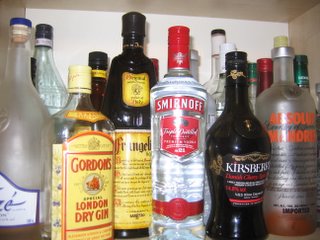
Here’s another pointless list. This time it’s a rundown of all the alcohol Jonas and I have in our liquor cabinet (which I should add is actually two spaces, one above our microwave and another in our linen closet!).

It seems we have 43 bottles at present:
gordon's gin; amsterdammertje jonge graengenever (genever/juniper); bacardi superior (white rum); malibu (coconut rum); mount gay dark rum; smirnoff vodka (triple distilled); 42 below manuka honey vodka; absolut citron (lemon vodka); absolut kurant (currant vodka); absolut mandrin (mandarin vodka); absolut vanilia (vanilla vodka); johnnie walker red label (scotch); tres generaciones reposado (tequila); bacchus butterscotch schnapps; baron von scheuters peach schnapps; continental cinnamon schnapps; de kuyper strawberry schnapps; berentzen sour apple schnapps; berentzen kirsch (cherry); alizé gold (passionfruit); bailey's (irish cream); baitz blue curacao (orange); baitz crème de menthe (mint); ‘the big strawberry’ wine; ‘bodega pedro romero’ pedro ximenez sherry (15yrs); campari (bitter orange); choya umeshu (japanese plum wine); cinzano bianco (vermouth); cointreau (orange); disaronno amaretto (almond); toschi amaretto (almond); f. meyer crème de mure (blackberry); frangelico (hazelnut); kahlua (coffee); kirsberry (cherry); marie brizard crème de cacao (chocolate); marie brizard crème de cassis (blackcurrant); midori (melon); montenegro (bitter orange); murdering point mulberry port; soho lychee liqueur; stone's ginger wine; vok triple sec (orange).

We have wines cellaring too, but that’s for another day . . . .

Saturday, 10 June 2006

sardines en escabèche - WHB

It's time for Weekend Herb Blogging again and this time it's bay leaves (or laurel leaves).
The recap is being hosted by Cate at Sweetnicks. To view the recap and check out other Weekend Herb Bloggers, click here.

Now, back to my bay leaves.

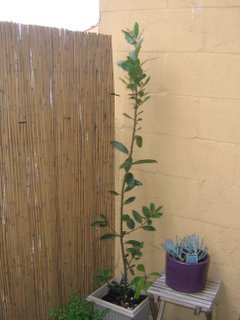
It's amazing what a few sprigs of herbs can do to lift a dish. The below recipe uses rosemary, thyme and bay leaves. Since we grow our own bay tree on our treacherously hot balcony I thought I should provide a recipe that uses it.

I am impressed that this little tree has survived since our balcony has zero protection from the sun and severe reflections from the glass ceiling of the plaza below us. We installed a bamboo fence as a shield from the glass, but this causes all our plants to grow straight upwards instead of branching out. As you can see from the photo, the poor tree is a little stressed and bean-pole like!

We like to cook with fresh bay leaves a lot of the time. They somehow add a certain fresh bay flavour that dried ones don’t produce. But you do need more of them when you use them fresh.

Bay leaves are also called laurel and were prized in ancient Greece where they were awarded as a wreath to winning athletes. Roman Emperor’s wore golden crowns of laurel and in fact the English word ‘bachelor’ comes from this herb through French from the Latin words bacca-laureus meaning laurel berry.

In Medieval times they used it to induce sweating (and even abortion) and since the leaves, oil and berries have narcotic qualities, some people smoke dried bay leaves to achieve an effect similar to marijuana!

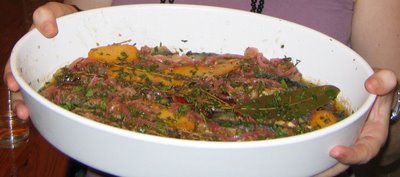
A month or so ago I discovered this Rick Stein recipe for sardines en escabèche. According to his book "My Favourite Seafood Recipes", the dish is of Spanish origin and is also popular in France (Provençal).

The recipe calls for whole sardines, but I thought it was a lot easier and tastier to use butterflied sardines. The herbs add fragrance and the peel provides a little citrus tang. Delicious!

Sardines en Escabèche
Recipe by Rick Stein. Serves 4.
Ingredients
12 sardines, gutted, cleaned and heads removed
50g plain flour, seasoned with salt and pepper
150ml olive oil
85ml red wine vinegar
1 medium onion, thinly sliced
5cm strip of orange zest
Sprig of thyme
Sprig of rosemary
1 teaspoon salt
1 bay leaf
4 garlic cloves, crushed
2 dried red chillies
Small bunch of flat-leaf parsley, chopped roughly
Method
1. Dust sardines in seasoned flour then fry them in half the olive oil for 1 minute on each side. Transfer to a shallow dish (non-reactive glass or ceramic).
2. To the frying pan add vinegar, onion, orange zest, thyme, rosemary, bay leaf, garlic, chillies and salt. Bring to the boil and simmer for 15 minutes.
3. Add the rest of the olive oil and parsley then pour the hot marinade over the sardines.
4. When cool, transfer to the refrigerator and leave overnight (can be kept for three days).
5. Serve with a green salad, sliced tomatoes and sliced capsicum.

happy thoughts to perth

Today is my brother Stephen's birthday. He's a Gemini, just like me and our younger sibling Stinky (Amy). I can't believe Steve is turning 38!!! I remember when he turned 20 and he was upset because he wasn't a teenager anymore. Now he's almost 40. He lives in Perth (on the other side of Australia which is effectively the distance of NY to LA) so I don't get to see him very often. This is a photo of me when I was under one and Steve was twelve. Happy Birthday Steve!!!

Friday, 9 June 2006

gazebo wine garden

Gazebo Wine Garden
2 Elizabeth Bay Road
Elizabeth Bay, Sydney, Australia
T: +61 2 9357 5333
www.gazebowinegarden.com.au
info@gazebowinegarden.com.au

Sorry folks, it's taken me a while to post this (two days). After Modena Delicious, Nicki, Fabio and I decided to wet our lips at the new kid on the block in Kings Cross.

Gazebo Wine Garden was a welcome retreat from the pouring rain and, at 10pm on a Tuesday night, we had a choice of bar table or lounge. I imagine earlier on or later in the week we'll have trouble getting in the door.

The interior was decorated in a style that seems to be popping up more and more frequently. I call it "schizophrenic op shop" and I think that gives you a pretty solid picture of the madness: shrubs growing out of the wall behind the bar, light fixtures adorned with creepy abandoned dolls and a taxidermied fox snarling at you from the ceiling (which actually disturbed me to no end).

They have two pages of wines by the glass, which is a great selection by any standards, although I have to admit there weren't that many that excited me. Certain varietals were repeated (chardonnay, cabernet, shiraz) whereas many favourites didn't make the cut (pinot gris/grigio – although there was quite a selection by the bottle). And there were only two rosés.

One glorious attribute is that you can buy wine by the half glass (75ml). This allows you to sample a lot of different wines over the course of an evening and is a fantastic development.

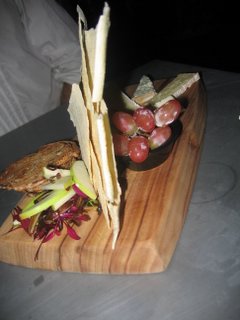
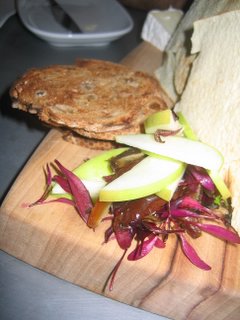
After a few sips of wine, we decided we needed a cheese board. The presentation was excellent, huge shards of crisp bread separating four French cheeses on one side and organic walnut raisin bread, apples and dates on the other. The board was decorated with tiny, red leaves that look like petals but turned out to be baby beetroot shoots (yes, I guessed correctly!). Unfortunately the size of the cheese servings was miniscule and for $22 this was a little steep. We had a white mould brie de nangis, a washed rind pont l'eveque, a semi-hard goat chabichou poitou and the blue papillon roquefort. All very good, especially the pont l'eveque.

Service was haphazard. We had an excellent waitress who could usually answer all questions and was quick to get the sommelier on technical wine queries. Unfortunately she let herself down when delivering the cheese board and couldn't remember what all the cheeses were. Considering there was only four, it was a bit of a slip up. When asked what the tiny purple leaves on the cheese board were, another waiter fumbled and had to check with the kitchen, although he did apologise with an emission that it was his job to know.

The sommelier couldn't translate the wine characteristics, launching into an overly complicated description and comparison before first gauging our level of wine knowledge. The use of esoteric babble was an attempt to cover up the fact that he didn't really know the difference between the two rosés. Unfortunately he was also a little vague, having taken our order he ducked outside for a cigarette and forgot to tell the bar. Ten minutes later another poor sod was beckoned over to take it again.

The wines we sampled were good and overall it was an enjoyable place. The crowd was affable and rambunctious (although verging on too-cool-for-school) and the food being served looked good. I would definitely come back because the vibe was buzzing but comfortable and the service, although confused, was very friendly. It's only been open for one month, so I suspect the service hiccups will soon smooth out nicely and all will be great.

Here's the rundown on the wine we tried (prices are by the glass):

2004 Eric Bordelet "Argelette" – Normandy, France ($9.00)
This pear cider was certainly an easy drink. Fragrant with pear and the lightness of white grape juice, but dry and certainly not too sweet.

2001 Château Maucamp 'Cru Bourgeois' – Haut-Médoc, Bordeaux, France ($18.00)
I liked this wine quite a lot and would hope so for the price tag. It had an excellent nose of ripe, red fruit and a full flavour on entry. I picked up a slight anise edge and couldn't miss the velvety fruit palate. There was a slight tannic end, but nothing unpleasant.

2004 Huia Gewurztraminer – Marlborough, New Zealand ($9.00)
This was a very light wine and even though it had the characteristics tropical notes expected, it wasn't very punchy. It was probably a bit too mellow for me, because I like my traminer on the spicy side.

2002 Schulz Vigeron "Johann" (Zinfadel) – Barossa Valley, SA, Australia ($9.50)
This was described as a "big, bold red" and they weren't wrong. It had a great nose of sweet red berries, an excellent flavour on entry and then a huge pepper kick in the mouth. Not to be trifled with.

2005 Scorpo Rosé (Pinot) – Mornington Peninsula, VIC, Australia ($12.00)
This was a great fruity wine with huge flavours and a dry edge. I adored it.

2001 Mauro Molino Barolo (Nebbiolo) – Langhe, Piemonte, Italy ($25.00)
Fabio said it was a classic Italian barolo with none of the big fruit flavours found in New World wines. I thought it had easy yet dry tannins on the palate, with a hint of tobacco and maybe even some liquorice. It was good, but not worth the price.

2005 O'Leary Walker Pinot Noir – Adelaide Hills, SA, Australia ($9.00)
Subtle oaks with dark berry and stone fruit flavoured. Fine tannins. Fabio thought it was very good for the low price.

2000 Marcevol (40% Grenache, 40% Carignan, 20% Syrah) – Côtes du Roussillon, France ($12.00)
Fabio was very pleased with the grand vin of this little known domaine. Red-black colour, concentrated palate and smooth tannin finish. His final evaluation "eminently quaffable".

You can also check out the Sydney Morning Herald's review of this venue.

Wednesday, 7 June 2006

modena delicious

Last night, Fabio, Nicki and I trundled off to a free dinner, Modena Delicious, showcasing the cuisine of Modena.

The event was held at Al Ponte Restaurant which, despite having to navigate through the neon-lit Harbourside shopping centre to find the entrance, was an elegantly subdued venue with a spectacular view of Darling Harbour. And because we were on the ugly side, the view across to Cockle Bay Wharf was great.

The event was organised by PROMEC (a promotional agency for the Chamber of Commerce of Modena), Modena a Tavola (an importer of Italian goods) and the Italian Chamber of Commerce in Australia. The premises was to trial Italian products on the public to see which items they liked and which items they think they'd buy themselves later. The menu included a canapé, appetiser, entrée, main and dessert.

The canapé was a crusty tigelline, little crisp breads traditionally made by the poor. It was topped with olive oil, parsley and porcini mushrooms. These were the slimy roasted kind I have enjoyed in Italy, not the rehydrated ceps we're forced to endure in Australia. I just adore roasted porcini so even though the tigelline was a little dry and plain, I was happy with this snack.

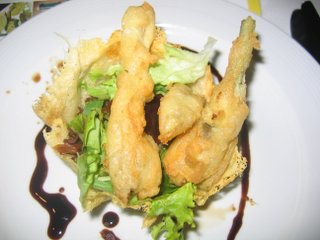
Next came an unappetising dish of artichoke hearts, dipped in batter and deep fried. The batter was light and the artichokes were well flavoured, but they arrived at our table cold making them quite unappealing. The artichoke pieces sat on a bed of green leaves dressed with exquisite honeyed balsamic vinegar and they were encased in a basket made of parmigiano reggiano. Unfortunately the tepid temperature of the dish accentuated the oiliness in the cheese and batter.

The pasta entrée was quite delicious, although nothing out of the ordinary. The napoletana sauce was made from roasted cherry tomatoes and good quality olive oil, but the pasta was a generic brand and the presentation was terrible. It was as if the chef just threw a cup of pasta into each bowl: there was a messy pile in the centre of a huge plate and then stray maccheroni plopped all over the place where they had landed. And Fabio received practically one third of the portion I did!

I was very happy with the main. I don’t really like chicken because I usually find it a dry and bland (and why kill an animal for mediocre flavour), but this small roast "bocconcini di pollo" had been skewered then chargrilled with rosemary, then wrapped with pancetta and served with a balsamic sauce. I really enjoyed it.

The dessert was an assiette: a gorgeous crème brûlée, a slice of a heavenly dark chocolate tart and a small spoon topped with cubes of clear coffee jelly. I was content with each one.

Overall, I walked away fairly unimpressed by the event. It was hard to understand which elements of the menu were the items on display and which were just local produce making up the rest of the meal. The chef in the restaurant didn't seem to care about the food he was producing, which was a bad career move considering that anyone attending will associate the final result with the chef, restaurant and products.

Nicki seemed to have a similar response to me and Fabio was not impressed at all (but then nothing much impresses Fabio).

But it was a free event and there were certainly elements of the meal that were happy discoveries.

Tuesday, 6 June 2006

caldo tlalpeño

Last night's dinner caused me to do some research on its name to find out where it came from.

Tlalpan is a municipality of the Mexican 'Distrito Federal': an independent self-governing area, separate from the rest of Mexico. The majority of Mexico City is located within the Federal District. The main indigenous language in Tlalpan was an uto-Aztecan language called Nahuatl, from which the word "tlalli" gave rise to Tlalpan's meaning "on the land".

This ancient borough is the source of a wonderful, light and sour soup which one could almost describe as Mexico's answer to tom yum.

The soup uses chipotle chillies, which for Australians are considerably hard to come by. My supplier is Fireworks Foods, an online store selling all things spicy, including seeds for rare chilli plants. Prices are very reasonable and delivery is swift.

For the uninitiated, chipotle are smoked jalapenos. The ones used in this recipe are those coming from a can with adobo sauce, so they're sweet, smoky and moist. You only use a few chillies in this recipe, so I freeze the remainder, individually wrapped, in a big freezer bag so I can access them in small portions in future.

We cook a vegetarian version, but traditionally this soup uses a rich chicken stock and chicken meat that has been fried then shredded. You can use this method if you prefer, or even add the chicken afterwards (which is what I usually do).

We were introduced to this soup by our wonderful friends: Mexican Robot and his honorary Mexican lady, Bicky.

Caldo Tlalpeño (Chipotle, Lime & Avocado Broth)
Vicky & Roberto's delicious recipe serves 3 main, 5 entrée
Ingredients1.6 litres rich vegetable stock
½ white onion, diced finely
1 carrot, cubed
400g can mixed beans (kidney, lima, chickpeas etc)
1-2 chipotle chillies in adobo sauce, depending on your taste
2 garlic cloves, crushed
Juice of 2 limes
1 avocado, cubed
2 corn tortillas (or flour)
2 tablespoons coriander, roughly chopped
Olive oil for frying
Method
1. In a pot with a little oil, sauté garlic and onion until transparent.
2. Add stock and carrot and cook until carrot is tender (give or take 20 minutes).
3. Meanwhile, slice tortillas into thin strips. Fry in oil until crispy.
4. Add chilli and beans then cook until warmed through and tender.
5. In serving bowls divide the lime juice and avocado cubes. Top with soup then coriander. Pass tortilla croutons separately.
Note: traditionally the soup uses chicken stock and shredded chicken poached in the broth.

Monday, 5 June 2006

airline meals - a dedicated website

I have recently been taking a lot of domestic flights for work and have become totally addicted to Qantas' coconut cake.

After careful inspection of the box, I discovered this scrumptious, moist and wonderfully delicious cake is made by Manna from Heaven, a shop near to my house. How delightful!

In honour of this airline ambrosia, Lustm referred me to a most interesting website called AirlineMeals.Net where the tagline is "the first and leading website about nothing but airline food".

The website has an extensive array of photos from almost every airline in the world and asks the submitter to give meals scores out of 10. They cover economy, business and first class meals equally and even have separate sections for special dietary requirements.

I had no idea there were so many subcategories of special meals on airlines: Asian vegetarian; Cholesterol; Diabetes (DBML); Fruit meal; Gluten free; Halal; Hindu; Indian vegetarian (AVMLI); Kosher; Lacto Ovo Vegetarian (VLML); Low calorie; Low fat; Oriental vegetarian; Seafood; Vegan; Vegetarian.

There are even photos of crew meals, some of which should be investigated by Occupational Health & Safety experts!

For those interested, my coconut cake can be seen on Qantas at entry 262.

I guess people are passionate about food even at high altitude!

Sunday, 4 June 2006

cabbage - weekend herb blogging

Time for weekend herb blogging! For the recap at Kalyn's Kitchen, please click here.

This week I’m focused on cabbage with two recipes:
1) seupa vapellenentse
2) garlic cabbage

The cabbage is a herbaceous flowering plant whose leaves form a tasty treat for humans and caterpillars alike. According to Wikipedia, the cabbage descends from a wild mustard plant from the Mediterranean around 100AD.

Cabbage can be eaten raw in coleslaw (yuck!), cooked into stews like borscht or pickled into delicious treats like sauerkraut or Korean kim chi.

Cabbage has been much maligned in modern time, perhaps because of the smell it produces when cooking (or the flatulence it often causes after ingestion), but it’s a healthy, nutritious herb that provides good dietary fibre.

Perhaps its high sugar and dietary fibre content led to creation of the strange cabbage soup diet, which encourages dieters to eat nothing but low-cal cabbage soup. Well, my soup certainly doesn’t fit into this category!!!

Seupa Vapellenentse is soooooooo bad for you because it’s loaded with cheese and butter (and bread), but it's worth the calories.

It’s such a shame that this delicious Italian soup looks so damn terrible. It didn’t matter which way I took the photo, nor how I tilted the light, it just looked like a pile of muck. But trust me, the soup is divine.

A few weeks ago I watched Antonio Carluccio, a London-based Italian-born TV chef, traipse through the Italian Alps in Valle d’Aosta, a tiny northern Italian province on the border with Switzerland and France. He made this traditional cabbage soup and I couldn’t wait to try it out myself.

I scanned a zillion internet recipes to come up with my own version, which turned out really well. But beware, it’s very rich so you don’t need, or want, much.

Seupa Vapellenentse
My own recipe, based on watching Antonio Carluccio and by scanning over other internet versions. Serves 4.
Ingredients
Small head of Savoy cabbage
300g fontina cheese
1 litre hot vegetable broth
400g stale bread, sliced thinly
¼ cup unsalted butter, melted
Butter for frying
Salt and pepper to taste
Method
1. Clean the cabbage, stripping away the toughest outer leaves and the hard core, and blanch the remaining leaves in salted water.
2. Drain them, cut them into thin strips, and transfer them to a pot with some melted butter. Sauté until they are nicely coloured.
3. Line the bottom of a deep pot with thin slices of the bread, then some of the cabbage mixture, salt and pepper and then a layer of thinly sliced fontina.
4. Continue to make the layers until all the ingredients are used up, with the last layer being fontina.
5. Add broth to just barely cover, pour over melted butter then cover with lid and leave for 20 minutes or until bread has softened and cheese has melted.
6. Stir the mixture very gently to ensure ingredients are evenly distributed.
Variations
For a meaty version, instead of using butter to sauté the cabbage, try 55g of cured lard or minced pancetta. Use beef stock instead of vegetable.

After cooking the soup, I still have some cabbage leftover so later in the week I plan to make a recipe that Jonas and I used to eat a lot but haven’t cooked in a long time: garlic cabbage. We’ll have it as a side to schnitzel (veal for me and soy for him). It’s based on an Australian Woman’s Weekly recipe (what would we Aussies do without them!) and is very simple and fast.

Garlic Cabbage
Australian Woman’s Weekly recipe, Serves 4 as a side dish.
Ingredients
30g butter
½ medium cabbage (750g), chopped coarsely
3 cloves garlic
¼ cup dry white wine
2 tablespoons chives, freshly chopped
Method
1. Heat butter in a saucepan.
2. Cook cabbage, garlic and wine, stirring, until cabbage is just tender.
3. Stir in chives just before serving.
Variations
For a spicier theme, add ½ teaspoon cumin seeds.

Don't forget to check out other Weekend Herb Blogging, this week hosted by Kalyn from Kalyn's Kitchen.

Saturday, 3 June 2006

around the world in 243 recipes

Today I discovered a food blog called Curiosity Killed the Cook, written by S.C. in Boston, USA.

What I really love about the blog is her ongoing project called Around the World in 243 Recipes where she plans the ambitious task of cooking something from every country in the world. I love the concept and the way she’s set out her alphabetical list with tiny thumbnail photos and links to the recipes she’s completed so far.

This is something I’ll be checking on regularly to watch S.C.’s progress and hopefully pick-up some tasty ideas along the way.

Friday, 2 June 2006

broccoli & anchovy pasta soup

It's cold, it’s raining, I'm sick and the doctor told me this morning that I'll probably have to get my tonsils removed. It’s a sad state of affairs.

To cheer myself up, last night I made a hearty broccoli and anchovy pasta soup, flavoured with garlic, chilli and tomato. Those familiar with Pugliese cuisine will recognise the excellent pairing of broccoli and anchovies. This is one of those recipes, like a puttanesca sauce, where the anchovies disintegrate into the food and provide the saltiness.

Unfortunately I forgot to take a photo last night so I took the snap today when I reheated the leftovers for lunch. The pasta had absorbed some of the liquid, so bear in mind that if you make the recipe you can expect it to have much more broth.


Broccoli & Anchovy Pasta Soup
This recipe comes from a cookbook called ‘Pasta Sauces’ by Jeni Wright. I made a few adaptations to increase the flavours. It should serve 2, depending on how greedy you are.
Ingredients
30ml olive oil
1 small onion, finely chopped
4 garlic cloves, finely chopped
1 fresh red chilli, seeded and finely chopped
5 anchovies in oil, drained
375ml passata
300ml dry white wine
1 litre vegetable stock
300g / 2 cups broccoli florets
200g / 1¾ dried pasta (shells, orecchiette or tiny pasta shapes)
Salt and pepper
Freshly grated pecorino or parmigiano cheese, to serve
Method
1. Heat olive oil in a large saucepan. Add the onion, garlic, chilli and anchovies and cook over a low heat, stirring all the time, for 5 – 6 minutes.
2. Add the passata and wine, with salt and pepper to taste. Bring to the boil, cover the pan, then cook over a low heat, stirring occasionally for 12 – 15 minutes.
3. Pour in the stock. Bring to the boil then add the broccoli and simmer for 5 minutes. Add the pasta and bring back to the boil, stirring. Simmer, stirring frequently until the pasta is al dente, approximately 7 – 8 minutes.
4. Serve hot in warmed bowls and top generously with grated cheese.

Tuesday, 30 May 2006

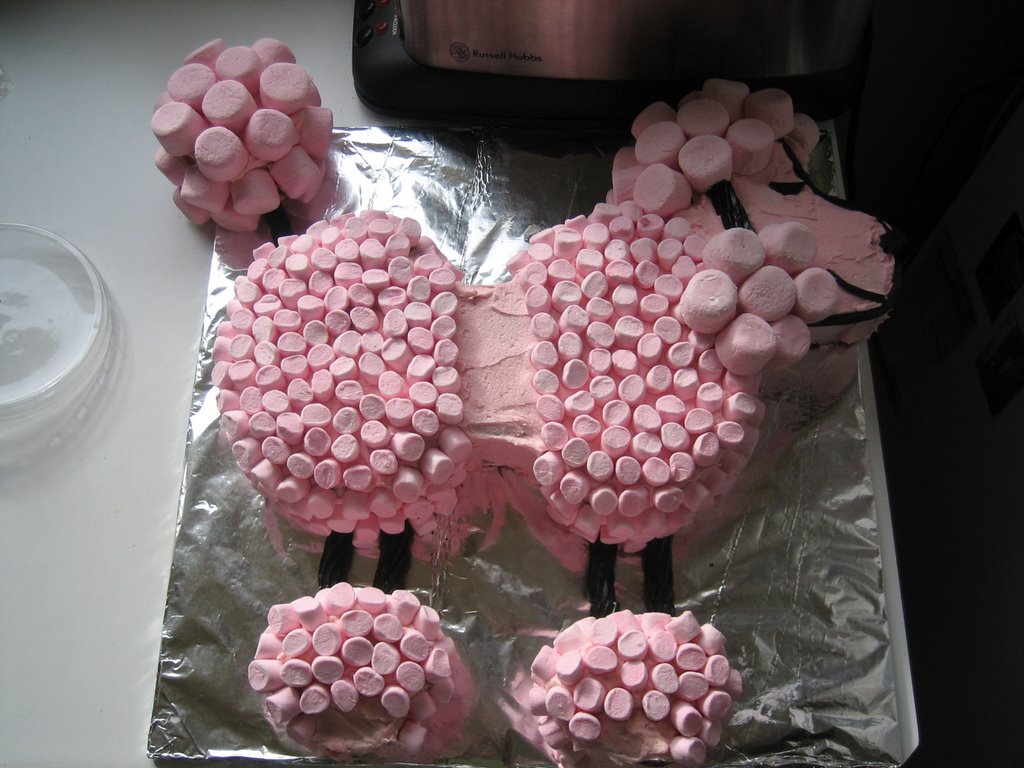
poodle cake on stinky's day

Couldn't resist putting this photo up, even though I wasn't the author of this canine masterpiece. My pal, Rob (aka Lustm), scooted off to Tasmania last weekend for his niece, Airlie's, first birthday party. Airlie's clever mummy, Jodie, made this sweet poodle cake and since it's just so adorable I couldn't resist posting the photo.

Speaking of birthdays, today my lovely little sister Amy gets another year older. Unfortunately she's on the other side of the world in London, or Spain, or is it Morocco – I've lost track! Let's just say she's far away and has been since she began her nomadic lifestyle almost two years ago.

Let's just name a few of the places she's been since she left: Thailand, Vietnam, Cambodia, Laos, China, Tibet, Nepal, India, Egypt, Spain, Italy, UK, Finland, France, Andorra, Netherlands and Turkey. Since she’s lives in ye olde London, there are a lot of other interesting weekend trips in the pipeline!

Happy Birthday Stinky! I miss you.

Monday, 29 May 2006

asia-pacific best restaurants list


Important work my friends!!! We have all been invited to vote for our favourite restaurants in Asia-Pacific.

Restaurant Magazine’s ‘The World’s 50 Best Restaurants 2006’ results, much like previous years, show a very European and American centric view of the world’s best restaurants. Of the Top 50, some 39 came from Europe and the top five countries were: France (10), USA (8), Spain (6), UK (6) and Italy (4).

In response to Restaurant Magazine’s revelations, Singaporean food blogger, Chubby Hubby, has decided to launch his own poll, Asia Pacific Best Restaurants List, to get a more accurate insight into our region’s shining culinary stars.

This survey is open to anyone around the world to vote on restaurants located in Asia-Pacific which includes the Indian subcontinent, the Central Asian states, all the Pacific Islands, Australia, Brunei, Cambodia, China, East Timor, Hong Kong, Indonesia, Japan, Laos, Macau, Malaysia, Myanmar, New Zealand, North Korea, Philippines, Singapore, South Korea, Taiwan, Thailand and Vietnam.

Voting ends on 12 June. To participate visit Chubby Hubby’s blog by clicking here.

Chubby Hubby, has a lot to say about the Restaurant Magazine results and his opinion is worth listening to: he was one of the 560 invitation-only voters that took part in Restaurant Magazine’s high profile survey. According to him “Of the 560 voters, 280 are from Europe, 78 from the Americas, 47 from Africa, 31 from the Middle East, 31 from Central Asia and Russia, 62 from Asia, and 31 from Australia and New Zealand”, which makes the whole survey skewed towards Europe.

Voters had to select two restaurants from within their region and three from outside their region. When understanding regions, it was extremely interesting to discover from Chubby Hubby’s blog that France was considered as one region whereas the somewhat ignorantly named ‘Far East’ included Brunei, Burma (not even Myanmar!), Cambodia, China, East Timor, Hong Kong, Indonesia, Japan, Laos, Macau, Malaysia, Micronesia, Nauru, North Korea, Philippines, Singapore, South Korea, Taiwan, Thailand, and Vietnam!!!!

Are we beginning to get the picture?

Chubby Hubby elaborates “Similarly, the UK & Ireland; the Benelux countries; Spain & Portugal; Denmark, Sweden and Norway; Italy; Austria, Germany & Switzerland; and the Baltics were distinct regions, each with 31 voters. Greece, Turkey, Cyprus and Georgia had 16 voters; Eastern Europe also had 16 voters. If you consider that every voter was asked to pick two restaurants from their own region, we get a minimum 560 required votes cast for European restaurants. In Asia, we have only a minimum of 124 required votes. Further, voters hailing from the Far East region are barred from voting for any other restaurants from the 20 countries in this region. A voter in France, however, can cast his or her 3 extra votes for restaurants anywhere in Europe outside of France. S/he can vote for restaurants in Spain, England, Germany, etc. Anyone can see that this survey is thus biased towards restaurants in Europe. No surprise then that 39 of the survey's top fifty are restaurants from Europe. From the "next fifty", 35 of 50 restaurants are based in Europe.

I agree with Chubby Hubby’s sentiments that if you’re going to claim ‘the Far East’ is one region then surely ‘Europe’ should be considered one region too? If we’re going to recognise that French, Spanish, Italian and even Basque dishes are all very individual then surely they can understand the difference between the cuisine of Thailand, China and Korea? I was also a bit surprised that not one Japanese restaurant was listed in the Top 100. When Japan’s cuisine is so internationally influential, and puts such high importance on quality ingredients and immaculate presentation, I find it hard to imagine it cannot place even one restaurant in the Top 100 of any reasonable global restaurant poll.

Don’t get me wrong – I’m not questioning the quality of any of the Top 100 restaurants, and I also think the results are a very valuable source of information on Europe and America’s best culinary destinations – but I do think in order for Restaurant Magazine to claim their list is truly the “world’s best” they need to expand their colonial concept of what constitutes the world.

Let’s try and even out some of the disparity. Please, vote in the Asia-Pacific Best Restaurants List before 12 June 2006!!!

asparagus – špargľa

When perusing Lucullian Delights, a blog by a Swede living in Italy, I discovered a fun weekly activity called Weekend Herb Blogging. This means writing about any green thing (herb, plant, vegetable or flower) that makes in onto your weekend menu or into your thoughts. Then someone hosts a recap of everyone's blogs on their own blog. This week's host is Ilva from Lucullian Delights.

To see the weekly recap, click here.

I think it's a fun idea so my first WHB is about last night's dinner: asparagus.

Back in 1999, I tracked down some long-lost relatives in Slovakia and went to Bratislava to meet them. Jozef and Viera (and their kids, also Jozef and Viera, but more easily identifiable as Jožko and Vierka – and not to forget Vierka's husband Karol) were the perfect hosts, filling me in on some of our family history as well as showing me around Bratislava and introducing me to strange and wonderful local cuisine.

On the Sunday, we journeyed north of Bratislava to their summer house (chata) in a place called Sekul, on the border of Austria and the Czech Republic. On the way they asked me when my birthday was and I shyly explained that it was on that very day. Immediately Jozef pronounced that they'd make me a birthday lunch, so he stopped the car and ran over to a small stall on the side of the road. I watched him buy huge bunches of asparagus and when I looked out over the fields I realised the rows of willowy crops were actually asparagus growing by the road side.

When we got to the chata, Viera trimmed the asparagus, which was so fresh it had dirt still clinging to it, and then I watched her turn it into a summer soup. I was a little nervous at this point, because I had never liked asparagus before, and I was loathe to turn down a dish that was prepared especially for my birthday.

On the first taste, I was in heaven. The soup was so light, creamy and fragrant with the fresh asparagus that I couldn't believe I didn't adore asparagus before. I ate it greedily and probably asked for a second helping. It was a wonderful discovery and something I'll always thank my Slovak relatives for.

There, amongst Slavic blood brothers, picturesque man-made lakes and abandoned WWI bunkers hidden in long green grass, I became an asparagus devotee.

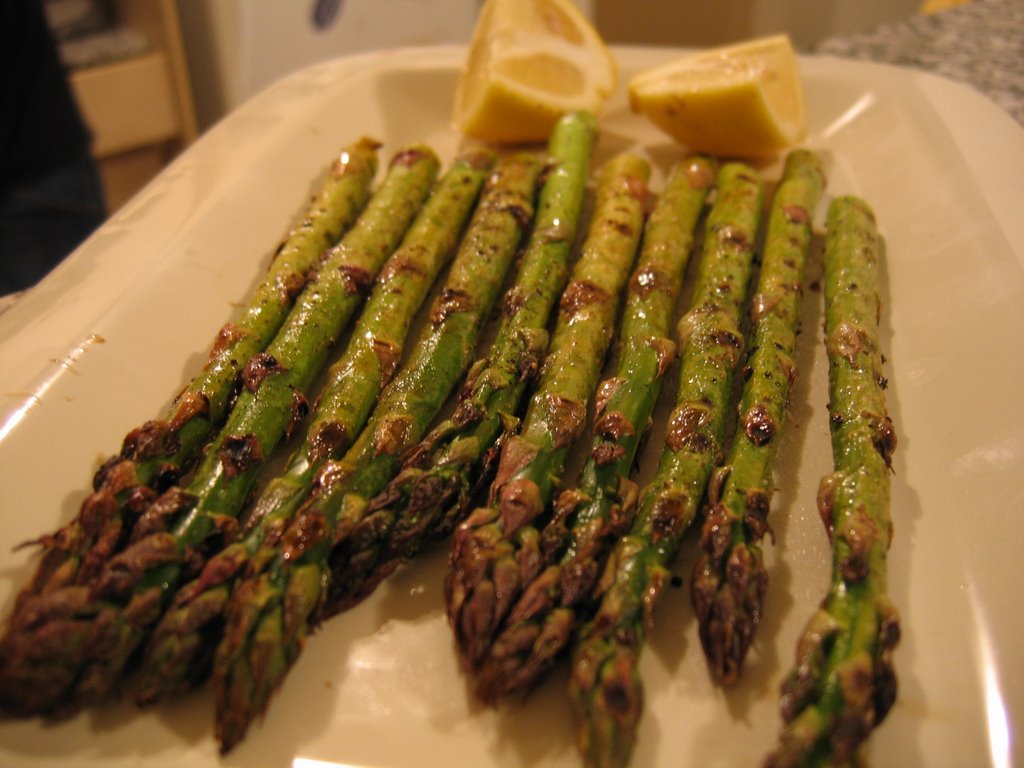
Even though asparagus isn't in season in Sydney at the moment (usually in season August to March), our local green grocer is selling some excellent bundles – green, firm and tinged with purple. Last night Jonas softened them on a smoking griddle pan with olive oil, rock salt, freshly crushed black pepper and a squeeze of lemon. Simple and delicious. Báječný!

Saturday, 27 May 2006

rosewater cupcakes

This is a recipe I created myself from a combination of various cake recipes on the net.

I first trialled it when hosting a friend's bridal shower and then I repeated the recipe for my own engagement party.

The cupcakes are light, delicious and look so very girly.

Rosewater Cupcakes
Anna's recipe. Makes 24.
Ingredients:
Cupcakes

375g butter, softened
6 eggs, room temperature
1½ cups caster sugar
1½ cups plain flour
¾ cup self raising flour
¾ cup almond meal
2 teaspoons rosewater
Icing
2 teaspoons rosewater
1-2 drops pink food colouring
1 tablespoon milk
1½ cups icing sugar
Method:
1. Preheat oven to 180°C. Grease two 12-hole patty tins. Line with paper cupcake holders.
2. Beat butter, rosewater and sugar in large bowl with electric beaters until very light and fluffy. Gradually beat in eggs, one at a time. Be sure to beat well to allow good aeration.
3. Stir in almond meal and flours.
4. Drop heaped tablespoons of mixture into cupcake holders. Bake for approximately 30-40mins or until cupcakes are lightly golden. Remove from tin and cool on wire rack.
5. For icing, mix rosewater, food colouring and 1 cup icing sugar. Once combined, gradually add milk until you reach the correct consistency. Add more icing sugar if needed. Spread over completely cooled cupcakes.
Related Posts with Thumbnails