

Jonas is obsessed with pizza. It’s his food of choice and over the past two weeks, while I have been away, he confessed that he ate pizza on most days.
Don’t get me wrong, Jonas can devour seven pizzas and a case of beer easily, but he also has a refined palate. I guess when you work in fine dining, during your time off all you crave is junk food.
His sudden fervour to make homemade pizza was welcomed and so I settled into my evening with a feast in store.
In the end he made margarita pizzas (tomato base, mozzarella and basil topping) as well as my all time favourite salad: blood orange and fennel.
We paired it all with a Sauvignon Blanc from New Zealand.
Basic Pizza Dough
Recipe from the Italian Cooking Encyclopedia. Serves 4 for main or 8 for an appetiser.
Ingredients:
2½ tablespoons fresh cake yeast or 1½ tablespoons active dry yeast
1 cup (250ml) lukewarm water
Pinch of sugar
1 teaspoon salt
3 – 3½ cups (350-400g) plain flour
Method:
1. Warm a medium mixing bowl by swirling it with hot water. Drain.
2. Place yeast in the bowl and add the cup of warm water.
3. Stir in the sugar and mix with a fork. Stand until yeast dissolves and foams, approx. 5-10 minutes.
4. Use a wooden spoon and mix in salt and one third of the flour.
5. Mix in another third of flour, stirring until dough forms a mass and pulls away from the sides of the bowl.
6. Sprinkle some of the remaining flour onto a clean surface and knead dough, working in a little of the remaining flour a little at a time. Knead for 8-10 minutes until you have elastic and smooth dough. Form into a ball.
7. Put dough into a lightly oiled mixing bowl, cover bowl with a moistened tea towel and leave to stand in a warm place until the dough doubles in size (approx 40-50 minutes).
8. To test whether dough has risen enough, poke with two fingers and if the indentations remain it’s ready.
9. Punch the dough down with your fist to release the air and knead for another 1-2 minutes.
10. Divide dough into however many pizzas you’d like to make and form into balls. Roll out with rolling pin to 5mm or ¼ inch thickness.
11. Place on lightly oiled pan, folding the extra dough over to make thicker edges. It is now ready for baking.

Jonas’ very own recipe. Serves 4 as a main or 8 as an appetiser.
Ingredients:
1 batch of basic pizza dough
3 – 4 cloves garlic, crushed
1 small onion, chopped finely
1kg ripe tomatoes, peeled and diced
1 cup (250ml) quality stock
1 tablespoon fresh oregano, chopped
¼ fresh basil, torn
2 ripe tomatoes, thinly sliced
400g mozzarella, grated
Sugar, salt and pepper
Olive oil
Method:
1. To make the tomato base, heat olive oil in pan. Fry onion and garlic until soft.
2. Add tomatoes, sugar, pepper and a splash of stock. Cook slowly until tomatoes breakdown (approx 30-40 minutes), adding stock if the mixture becomes too dry.
3. Once it becomes a thick sauce, taste for seasoning and add oregano. Cook for 2 minutes more and then remove from heat.
4. Preheat oven to 220’C – 230’C.
5. Spread tomato sauce over pizza base. Top with fresh tomato slices and generous amounts of mozzarella.
6. Bake in oven for 10-15 minutes or until base is sufficiently crispy.
7. Sprinkle with torn basil and a dash of olive oil. Serve!
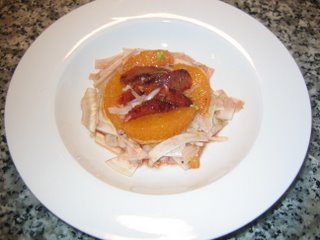 This was inspired by Spanish salads that combine the sweetness of orange with an acidic dressing and olives. We decided to use blood oranges to add a little colour and fennel to add texture and crunch. Even though I’m not at fan of fennel, I adore this salad.
Blood Orange, Fennel & Olive Salad
Anna & Jonas’ very own recipe. Serves 2-3.
Ingredients:
Salad
1 baby fennel
2 blood oranges
1 navel orange
½ Spanish onion
½ cup quartered kalamata olives
Dressing
2 – 3 tablespoons olive oil
1 tablespoon lemon juice
½ tablespoon white wine vinegar
½ tablespoon reserved orange juice
Method:
1. Segment navel orange over a bowl to catch the juices. Segment blood orange but do not retain juice (this will make the blood orange's colour stand out more brightly).
2. Shave fennel with potato peeler to get paper thin slices.
3. Slice onion into paper thin half moons.
4. Place fennel, onion, olive and orange segments into a bowl. Season with salt and pepper.
5. In a small bowl add olive oil, lemon juice, white wine vinegar and orange juice. Mix then adjust to suite your tastes, bearing in mind the dressing should be acidic to balance the sweetness of the fennel and orange.
6. Dress the salad and serve.
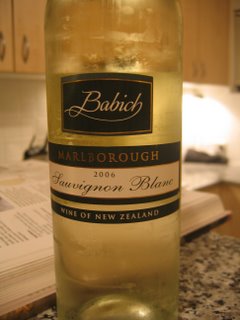 And as a grand finale, we even made our own tasting notes for the wine:
2006 Babich Sauvignon Blanc – Marlborough, New Zealand
Colour: pale straw with a greenish tint
Nose: strawberry hubba bubba; strawberry flavouring; gooseberry; passionfruit
Palate: sweet, passionfruit entry; citric middle; medium, acidic finish.
Verdict: enjoyable; good summer wine.
 Which herb should be the focal point of this festa italiana for Weekend Herb Blogging?
We have basil, which I’ve blogged about before on a previous WHB; there’s oregano in the tomato base and a great fennel salad?
I think I’ll go with fennel on this occasion.
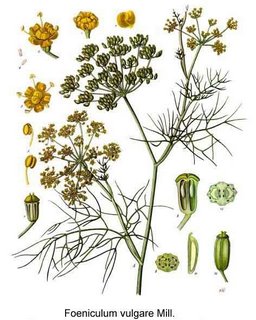 Fennel (Foeniculum vulgare) is native to southern Europe (mostly the Mediterranean) and south-west Asia. As part of the Umbellifereae family, fennel is closely related to parsley, carrots, dill and coriander.
It is an aromatic perennial, with aniseed flavours, and the bulbs, stalks, leaves and seeds are all edible.
In Ancient Greece and Rome, fennel was well regarded for its medicinal value. In Greek myth, it was in a fennel stalk that Prometheus carried coal from Mt Olympus and thus passed fire from the gods to people.
The English word fennel comes from the Latin fenum / fœnum (hay) into feniculum / fœniculum (little hay or fennel) through Anglo-Saxon fenol / finol into Middle English fenel / fenyl and finally into Modern English and the word we know today.
It’s also interesting to note that fennel gives us the word marathon also. After the famous battle between the Greeks and the Persians in 490BC, Pheidippides ran some 42km from Marathon to Athens to announce that the Greeks had won before collapsing to his death. His long distance run was named after the battle, but the plains of Marathon were so named because fennel had grown there in abundance μάραθον = marathon = fennel.
The Anglo-Saxons considered fennel sacred along side eight other sacred (and now quite unusual) herbs: mugwort, greater plantain, watercress, wild chamomile, stinging nettle, crab apple, chervil and viper's bugloss.
During the Medieval period, fennel was used as an insect repellent as well as to ward away evil spirits.
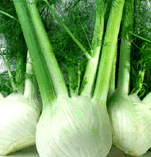 Fennel can now be found growing wild along roads and in fields throughout the world, since it is easily grown by seed. In fact in the USA and Australia it is often classified as a weed.
Today, the leading commercial growers are the United States, France, India and Russia.
The bulb of Florence fennel (F. vulgare Azoricum Group) is also eaten and has a much sweeter flavour than the seeds and leaves. Florence fennel was one of the three main herbal ingredients used to make traditional Absinthe, although modern day production usually omits it.
Fennel bulbs can be served raw in salads, braised, blanched or marinated.
Fennel seed is dried and used in cooking and in India the seed is coated in candy and eaten as a sweet treat or chewed as a breath freshener. They must be onto something because fennel is an ingredient in many natural toothpastes.
Fennel is also important in Chinese five spice mixes, satay, garam masala mixes as well as panch phoron, a Begali spice blend. In Italy it is used to flavour sausages and rye breads in northern Europe.
I was surprised to learn that fennel pollen contains the strongest fennel flavour, but as you can imagine it is expensive to come by.
Fennel’s flavour comes from its volatile oil anethole, also called anise camphor and aniseed oil. According to Wikipedia, “chemically, it is an aromatic, unsaturated ether” and is related to estragole, a compound in tarragon and basil. Anethole is 13 times sweeter than sugar but is also slightly toxic and can be an irritant in large quantities. Artificial hallucinogens synthesised from anethole (eg paramethoxyamphetamine) are used to make ecstasy tablets.
 Traditionally fennel was used as a diuretic and to induce milk production for new mothers. It was also used to cure chills and digestive troubles in the form of fennel seed infused hot water. Fennel tea also assists babies with colic.
Today fennel is said to have a range of medicinal properties including anti-inflammatory and anticancer effects because the anethole shuts down a signalling process that triggers gene-alteration.
Fennel bulb is an excellent source of vitamin C and immune system boosters, preventing osteoarthritis, rheumatoid arthritis and recurrent ear infections as well as decreased risk of colon cancer.
Fennel is also a very good source of potassium, lowering high blood pressure.
Fennel essential oil is used in soaps, and some perfumes as well as cough medicine. The Garden Guides website also recommends fennel as a soothing eyewash.
That’s it for my Weekend Herb Blogging. This week’s recap is being hosted by Ruth at Once Upon A Feast in Canada. Be sure to check out her recap.

References & photo sources
http://en.wikipedia.org/wiki/Fennel
http://en.wikipedia.org/wiki/Anethole
http://www.whfoods.com/genpage.php?tname=foodspice&dbid=23
http://www.gardenguides.com/herbs/fennel.htm
Tags: morsels and musings food blog food and drink australia recipes weekend herb blogging whb fennel orange blood orange pizza wine sauvignon blanc new zealand italy italian recipes italian italian food salad main snack appetiser



 Batata bil Kizibra (Potatoes Coriander)
 Coriander and Yoghurt Chutney


 The interior was like a space ship kitted out in western gear – shining metal surfaces and organic egg shaped light fittings alongside marbled brown and white cow hides and exposed dark wood beams.

 Butterflied sardines ($8.50) came with crispy breadcrumb, parsley and pine nut tops. The fish was wonderfully oily and rich and matched the herby breadcrumbs well.
 Seared sirloin slices ($12.30) were wonderfully rare and topped with a tangy dressing of soy, lime, chilli and ginger. It was an attractive dish with an invigorating flavour.
 For main there wasn’t too much choice for our vegetarian, so Jonas settled on the bintje potato gnocchi with gorgonzola and spinach ($24). He commented that the gorgonzola wasn’t as strong as he would have liked but that the texture and flavour of the gnocchi made from bintje potatoes was exceptionally good.
 Nicki’s ocean trout ($28) looked exquisite, served with fennel, Jerusalem artichoke, blood orange slices and garlic mayonnaise. She was pleased with the overall flavour composition, but it was disappointing that a significant portion of her fish was raw (no, not rare, raw). This was only one half of the trout so we suspect it wasn’t the chef’s intention.
 My lamb cutlets ($31) were also close to undercooked, but I was happy with the flavours in the parmesan crumbing. Three cutlets to one serve was generous and I couldn’t finish one of them. The roasted baby carrots and caramelised shallots matched the lamb perfectly and I was quite impressed with the overall dish.
 I finished the meal with a fruit trifle ($12). A compote of rhubarb, raspberries and strawberries were layer with cream, jelly and a little sponge cake to make a fruity, but rich finale.


 I am a huge fan of antipasto. The idea of snacking on a variety of different flavours and textures is so much more exciting than ploughing through a huge plate of one dish.
 Pan-Roasted Artichokes with Lemon & Garlic
 Records show artichokes being grown in Sicily as early 287B.C. In the 1st century A.D. rich Romans ate artichokes with honey, vinegar and cumin.


 Fabio chose the pan fried quail as his entrée ($17). It was accompanied by pancetta and slices of pickled pear. Shreddings of radicchio treviso gave a perfect bitter contrast to the generous lashings of a rich, dark jus. Even though it was an intense and heavy start, I adored this dish and thought the flavours were paired skilfully.
 Upon Fabio’s suggestion, for my main course I ordered one of the most exquisite dishes I have ever tasted: vincisgrassi ($25). This layered pasta from the Marche region has been found in records dating back to the late 1700s. Buzo’s version of vincisgrassi is fairly faithful to the original recipe using pasta sheets sandwiched between porcini mushrooms, prosciutto and truffles. The intense flavour combinations were simply superb and I cannot recommend this dish highly enough.
 Fabio and Julia shared the baked chocolate ($14.50) which had a soufflé like consistency and was sprinkled with flaked almonds. It was absolutely wonderful and came with a scoop of vanilla ice cream.


 When I suggest tequila to most people, the common reaction is “Oooohhh no, not tequila. I always feel sick from tequila. I got trashed on tequila too many times that I just can’t drink it anymore.” Or the second most popular reaction is “Tequila is disgusting”.
 Joven / Blanco – bottled very quickly after distilling (aged less than 60 days), clear, sometimes golden, young flavour
