Saturday, 4 July 2009

peanut butter pie & roasted banana ice cream


Today is the Fourth of July.

In the wee hours of the morning, after 26hrs of travelling, Jonas and I will have arrived in Daytona Beach (Florida), ready to celebrate the day in the humidity and heat with my aunt, cousin and 90 year old grandfather.

Jonas is over the moon because it’s the first time he will visit mainland USA and we’re spending the day at the Daytona NASCAR . . . on Independence Day.


In preparation for this momentous day, I preblogged this WHB post with an American flavour.

What’s more American than peanut butter? And combining it with chocolate?
Genius! A salty-bittersweet symphony.

And add to this combination some banana? Even better!

Thus you have Maggie Beer’s peanut butter pie with David Lebovitz’s roasted banana ice cream. Delicious!

The ice cream has the most delectable flavour of sweet, caramelised banana but it's best eaten on the day of making as it can get a little icy if left too long in the freezer.

The pie is divine, but it's very rich and fudgy. The filling would be overwhelming but paired with the ganache topping it takes on a wonderful cheesecake salty-sweet-sourness.

Don't be tempted to use smooth peanut butter, the crunchy texture is necessary.


Peanut Butter Pie

Recipe by Maggie Beer in Delicious Magazine March 2009. Serves 16.

Ingredients:

Base
180g digestive biscuits
90g unsalted butter, melted
3 teaspoons caster sugar
Filling
1 cup (250ml) pouring cream
1/3 cup (75g) caster sugar
320g cream cheese, room temperature
375g crunchy, salt-free peanut butter
Topping
150ml thickened cream
150g 70% cocoa chocolate, chopped
20g unsalted butter

Method:


1. Preheat oven to 180’C (160’C for fan forced)

2. Process biscuits in a food processor until crumbled.

3. Add melted butter and sugar then pulse to combine. Press crumbs into the base of a 22cm spring form baking tin.

4. Bake base for 10 minutes then set aside to cool.

5. For the filling, place the cream and sugar in a saucepan and simmer on low for 3-4 minutes, stirring until the sugar dissolves.

6. Chop the cream cheese then blend with peanut butter, in a food processor, until combined.

7. Add the warm cream mixture, pulse to combine and then spoon filling onto the cooled cookie base. Set aside to cool.

8. To make the topping, combine the chopped chocolate and butter in a heatproof bowl.

9. Bring the cream almost to the boil over high heat then pour over chocolate and butter.

10. Leave for 3 minutes without touching then gentle swirl the bowl to combine the cream, butter and chocolate.

11. Pour the combined topping over the filling then chill in the fridge, uncovered, for 4 hours until set.

12. Serve small slices with ice cream because it’s very, very rich!


Roasted Banana Ice Cream

Recipe from
The Perfect Scoop by David Lebovitz. Makes 750ml.
Ingredients:
3 medium-sized ripe bananas, peeled
1/3 cup (70g), packed brown sugar
1 tablespoon butter, cut into small pieces
1½ cups (375ml) whole milk
2 tablespoons caster sugar
½ teaspoon vanilla extract
1½ teaspoons freshly-squeezed lemon juice
¼ teaspoon coarse salt

Method:

1. Preheat the oven to 200’C.

2. Slice the bananas into 2cm pieces and toss them with the brown sugar and butter in a 2 litre baking dish.

3. Bake for 40 minutes, stirring just once during baking, until the bananas are browned and cooked through.

4. Scrape the bananas and the thick syrup into a blender or food processor.

5. Add the milk, granulated sugar, vanilla, lemon juice and salt, and purée until smooth.

6. Chill the mixture thoroughly in the refrigerator, then freeze it in your ice cream machine according to the manufacturer's instructions.

Note:
If the chilled mixture is too thick to pour into your machine, whisking will thin it out.


Banana would be an all-too-simple choice of ingredients for WHB, so I’m going to focus on peanuts.

Did you know they aren’t actually nuts but legumes?

After pollination, the fruit changes into a legume

Yet another wonderful food gift from the abundant Americas, it’s amazing to think what our meals would like without this vast continent. The Americas gave the world pecan, avocado, cashew, passionfruit, turkey, pineapple, chocolate, pumpkin, quinoa, guava, papaya, strawberries, vanilla, allspice, potato, tomato, chilli and maple syrup.


Despite having come from South America, the peanut’s journey into the USA came from Africa through Portugal and Brazil.

Apparently our domesticated peanuts have two sets of chromosomes from two different species, leading scientists to believe domestication occurred in Argentina or Bolivia.

The oldest peanuts found by archaeologists are some 7,600 years old, making them a pretty old fashioned snack!

China leads world production of peanuts, followed by India and then Nigeria. The next largest producers of the top ten are the United States, Indonesia, Myanmar, Argentina, Vietnam, Sudan and Chad.

Peanuts are a rich source of protein, niacin (good for the brain) antioxidants, resveratrol (anti-aging), vitamin B3, vitamin E, magnesium, folate, dietary fibre and monounsaturated fats.


Interestingly, peanut allergies are exacerbated by roasting peanuts. The roasting process increases peanut allergens Ara h1 and Ara h2 and inhibits the necessary digestive enzymes. In other countries like India and China, where peanuts are not roasted before processing, allergies are very rare.

Studies are also showing that exposing children to peanuts much later in life decreases the chances of developing peanut allergies

Whatever the cause, peanut allergies are extremely dangerous and can cause immediate anaphylactic shock just by eating food processed by machines that touched peanuts or by breathing peanut dust.

So that's it from me. Head on over to our WHB host, the lovely Laurie from Mediterranean Cooking in Alaska and Happy 4th of July!


Other peanut recipes:
African Peanut Soup Kalyn's Kitchen
Candied Peanuts David Lebovitz
Carrot & Peanut Muffins Chocolate & Zucchini
Chipotle-Maple Peanut Brittle Culinary in the Country
Chocolate Peanut Butter Cake Smitten Kitchen
Chinese Fried Noodles w Spicy Peanut Sauce Morsels & Musings
Groundnut Chutney Mahanandi
Homemade Peanut Butter Cups Baking Bites
Honey-Roasted Peanut Butter Joy The Baker
Lime & Peanut Coleslaw 101 Cookbooks
Peanut Butter & Banana Milkshake Morsels & Musings
Peanut Butter Marshmallow Crispy Brownies The Cooking Photographer
Toasted Peanut Bread 101 Cookbooks
Virginia Peanut Soup CookThink


References:
http://en.wikipedia.org/wiki/Peanut
http://en.wikipedia.org/wiki/Peanut_butter

Thursday, 2 July 2009

buffalo wings w blue cheese dip


Apologies for disappearing again! After recovering from the inner ear virus, can you believe I contracted a cold and was knocked out for another 3 days! Looks like I might have given it to Jonas too.

Despite it all, tomorrow Jonas and I are flying off to the USA for 2 weeks.

The first week we’ll be in Daytona (Florida) with my grandfather, aunt and cousin and then the second week we’ll kick back in New Orleans (Louisiana).

Even though the present winter in Sydney is more like spring, the sultry humidity of the South is going to be a shock to our senses.

Visiting New Orleans will make Louisiana my 28th state. Somewhere between a father from LA, grandparents from Pennsylvania, family in the south-east and south-west states and doing my own time in NYC, I’ve managed to see a fair whack of the US.

I doubt I’ll have any time at all to blog while we’re away, so I have pre-written some posts and scheduled them to pop up intermittently throughout our vacation period. In line with the destination, I’ve chosen to post mainly American inspired recipes:
- Buffalo Wings w Blue Cheese Dip
- Peanut Butter Pie
- Roasted Banana Ice Cream
- Beef Jerky
- Southern Belle (nectarine & bourbon cocktail)

Now, first off I have to apologise for the quality of this buffalo wing photo. The reality is that once these suckers were out of the oven then feeding frenzy was on and I was lucky to get this crappy shot. The blue cheese dip didn’t even get a photo before wings were submerged.

So, ignore the unappetising happy snap and just imagine these glorious little suckers in your belly!

I have to say, making these in Australia was somewhat expensive. The chicken wings are very cheap, but Louisiana-style hot sauce is a rarity in Australia. Given that I am totally addicted to the stuff and it’s impossible to come by (and therefore expensive), using so much in one dish made me squirm with discomfort.

It was like throwing beluga caviar on baked beans.

But I persevered and the results were well worth it. I even set aside some of the sauce for Jonas to marinate his tofu in and he was overjoyed with the results.

These are not my recipes, but a Recipe Road Test from Elise from Simply Recipes.


Buffalo Wings

Recipe by Elise from Simply Recipes. Serves 4.

Ingredients:

2 lbs chicken wings (about 12 wings)
3 Tbsp butter, melted
4 Tbsp bottled hot pepper sauce (like Crystal or Frank's Original)
1 Tbsp paprika
1/2 teaspoon salt
1/2 teaspoon cayenne pepper
1/4 teaspoon black pepper
Blue cheese dip (see below)
Celery sticks (optional)

Method:

1. Cut off wing tips (discard or reserve for other use such as making stock). Cut wings at the joint.

2. Put chicken wing pieces in a plastic bag. Set aside.

3. Create a marinade by stirring together the melted butter, hot pepper sauce, paprika, salt, cayenne pepper and black pepper.

4. Reserve 2 tablespoons of the marinade for coating after the pieces come out of the oven.

5. Pour remaining marinade over the chicken pieces in the plastic bag. Seal the bag and let marinate at room temperature for half an hour. When marinating is finished, discard marinade and bag.

6. Place wing pieces on the rack of a grill pan. Grill 4 to 5 inches from the heat for about 10 minutes on each side, until chicken is tender and no longer pink.

7. Remove from oven and baste with reserved marinade.

8. Serve with Blue Cheese Dip and celery sticks. Makes approximately 24 pieces (about 12 appetizer servings).


Blue Cheese Dip

Recipe by Elise from Simply Recipes. Makes 1.5 cups.

Ingredients:

½ cup sour cream
½ cup crumbled blue cheese
½ cup mayonnaise
1 Tbsp white wine vinegar or white vinegar
1 clove garlic, minced

Method:


1. Combine dip ingredients in a blender or food processor.

2. Blend or pulse until smooth.

3. Cover and chill. Keeps for up to one week in fridge.

Monday, 22 June 2009

tangelo delicious pudding


I have just suffered through a week of vertigo due to an inner ear virus which seems to be sweeping Australia’s east coast.

I feel like I just stepped off a roller coaster. The dizziness is ever, ever present. Every moment.

So this dessert was a Sunday evening thank you to Jonas, who tenderly nursed me over the past week and patiently put up with my demands for pretty much everything a girl could demand.

Tangelo Delicious is a twist on the traditional Lemon Delicious: a warm citrus dessert with an aerated cake top and a gooey fudge base.

Perfect winter fare that’s so light it’s easily transferable to summer.


Tangelo Delicious Pudding

Based on a recipe from
The Essential Dessert Cookbook. Serves 4.
Ingredients:

60g unsalted butter, softened
¾ cup (185g) caster sugar
3 eggs, separated
1 teaspoon grated tangelo rind
1/3 cup (40g) self raising flour
¼ cup (60ml) tangelo juice
¾ cup (185ml) milk
Oil, for greasing

Method:


1. Preheat oven to 180’C.

2. Brush a 1 litre ovenproof dish with oil.

3. Using electric beaters, beat the sugar, egg yolks, butter and tangelo rind until the mixture is smooth and creamy.

4. Sift in the flour and stir (with wooden spoon) until just combined.

5. Add tangelo juice and milk and stir until combined.

6. In a new (very clean, very dry) bowl, beat egg whites with (very clean, very dry) electric beaters until firm peaks form.

7. Fold in pudding mixture with a metal spoon until just combined. You want to try and keep as much air as possible.

8. Spoon into the ovenproof dish and place in a large, deep baking dish. Pour boiling water into baking dish until it comes one-third of the way up the side of the pudding dish (this will keep an even temperature and retain moisture during cooking).

9. Bake for 40 minutes. Dust with icing sugar and serve warm.


Using the tangelo, this is my entry to Weekend Herb Blogging.

Tangelos (Citrus paradisi × Citrus reticulata) are deliberate and accidental hybrids of tangerines (orange x mandarin) and pomelos (grapefruit).

Thought to have originated in South East Asia more than 3,500 years ago, they are one of the most juiciest of the citrus fruits with a refreshing acidity and tapered “nippled” shape.

Their soft skin makes them easier to peel than oranges and some of the more well-known cultivars include K–Early, Minneola, Nova, Orlando, Seminole, Thornton, Alamoen and Ugli.

The current Weekend Herb Blogging host is Astrid from Paulchen's Foodblog so be sure to visit for the recap.

Other Tangelo Recipes:Candied Tangelo Peel Hot.Sour.Salty.Sweet. And Umami
Mango Tangelo Chutney The Bacon Show
Roasted Branzino w Tangelo-Olive Tapenade Scrumptious Street
Salmon w Lime-Tangelo Yoghurt Sauce Beetses
Tangelo-Buttermilk Scones Lisa is Cooking
Tangelo Caprioska Morsels & Musings
Tangelo-Coriander Brown Rice Pilaf Scrumptious Street
Tangelo Cheesecake disciplined self indulgence
Tangelo Creme Tart Sweet & Savory Eats
Tangelo Flan Brulee Cook Eat Fret
Tangelo Marmalade Vegan Yum.Yum
Tangelo Pork Stir-Fry Culinary in the Country
Tangelo Sorbet The Chocolate Gourmand
Tea Cake w Sticky Tangelo Syrup Souvlaki For The Soul

References:
http://www.hort.purdue.edu/newcrop/morton/tangelo.html
http://en.wikipedia.org/wiki/Tangelo
http://images.smarter.com/blogs/Tangelo.jpg

Wednesday, 3 June 2009

roast pork fillet w cider & pistachios

 
This is another of my Autumn inspired dishes and it’s been perfect during the torrential rain Sydney has been experiencing lately.

But I imagine this dish would be equally good as summer afternoon roast if you sat outside and let the warm weather touch your skin.

The colours are so pretty and the flavours are quite elegant. I’m a big fan of this quick and easy roast.


Roast Pork Fillet w Cider & Pistachios
Anna’s recipe inspired by
Stephanie Alexander. Serves 2.
Ingredients:

350g pork fillet
¼ cup shelled pistachio nuts, chopped
1 red onion, sliced
2 garlic cloves, sliced
3 sprigs lemon thyme
½ cup apple cider
Fleur de Sel, to taste
Freshly milled pepper, to taste
Olive oil

Method:


1. Preheat oven to 180'C.

2. Trim the pork fillet of sinews and fat. Rub with olive oil, lemon thyme and pepper. Refrigerate for 30 minutes.

3. Heat some olive oil in a large frying pan. Saute the onions and garlic until oftened then transfer to a baking dish.

4. Heat a little more olive oil on high before browning the pork for 4 minutes then turn and brown the other side for 3 minutes.

5. Remove pork to the baking pan and sit on onions.

6. Deglaze the frying with apple cider. Simmer for 5 minutes until reduced a little.

7. Pour over pork then sprinkle pork with pistachio nuts and fleur de sel.

8. Bake in the oven for 20 minutes or until cooked through but still pink and tender.

9. Transfer juices to frying pan and reduce a little further.

10. Serve pork in slices, drizzled with pan juices and accompanied by a salad of bitter greens or roasted brussels sprouts and baked potatoes.


This dish relies heavily upon the fragrant flavours of lemon thyme, which is my theme ingredient for Weekend Herb Blogging.

Lemon thyme (Thymus citriodorus) is a cross between common thyme and the more aromatic thymus pulegioides. This hybrid produces a gorgeous citrus scented herb with medium green foliage and small lilac flowers.

Native to Europe, Asia, northern Africa it is used in the cuisines of most countries in these regions as well as the Caribbean

Thyme was used by the Ancient Egyptians for embalming, the Ancient Greeks in their temples, by Romans to purify their rooms and by Medieval Europeans to ward away nightmares. Hmm?

Thyme symbolises courage and is also known as a good source of iron.

This is my entry for Weekend Herb Blogging, hosted by WHB's very own manager Haalo from Cook (almost) Anything At Least Once.

Other lemon thyme recipes:
Dried Strawberries & Lemon Thyme Shortbread - Cupcake Muffin
Lemon Thyme Bars - Not Eating Out in New York
Lemon Thyme Chicken Nuggets - Butter & Sugar
Lemon Thyme Crème Brûlée - Chocolate & Zucchini
Lemon Thyme Cupcakes - Fresh Approach Cooking
Lemon Thyme Curd - Tartelette
Lemon Thyme Gimlet - Slashfood
Lemon Thyme Green Beans - Sugar & Spice
Lemon Thyme Sorbet - Andrea Meyers
Lemon Thyme Tea Bread - Cafe Lynnylu
Mushroom & Lemon Thyme Soup - Nami Nami
Noodles w Creamy Chicken & Lemon Thyme - A la Galadrielle...
Pan Seared Scallops w Lemon Thyme Drizzle - That's Not What the Recipe Says
Pork w Lemon Thyme Sauce - Bear Necessities
Ricotta Gnocchi w Lemon Thyme Butter Sauce - Technicolor Kitchen
Vodka-Thyme Lemonade - Appetite for China
Zucchini Carpaccio w Avocado & Lemon Thyme - The Wednesday Chef

References:
http://www.backyardgardener.com/plantname/pda_1be1.html
http://en.wikipedia.org/wiki/Thyme
http://www.villageherb.com.au/herb_info.htm

Wednesday, 27 May 2009

persimmon & bourbon bread


I’ve been very inspired by Autumn this year. It seems to have captured my imagination.

Chestnuts, brussel sprouts and pears have all featured on my menu lately.

Last weekend I cooked up a feast, preparing roast pork loin w cider and pistachios, pickled sausages, quince jam and this delectable persimmon bread.

Persimmons have baffled me because I never knew what to do with them. They always seemed tasteless with a clammy texture, but I realised I just wasn’t using them correctly.

Fuyu persimmons, squat and round, should be eaten fairly firm. You peel the skin and either eat whole or in slices. Paired with a top quality vanilla yoghurt they are simply divine.

Hayicha persimmons are the ones you want to cook with. They are more elongated that Fuyu and when ripe the interior becomes a jelly mush that's perfect for purée, jam and cakes.


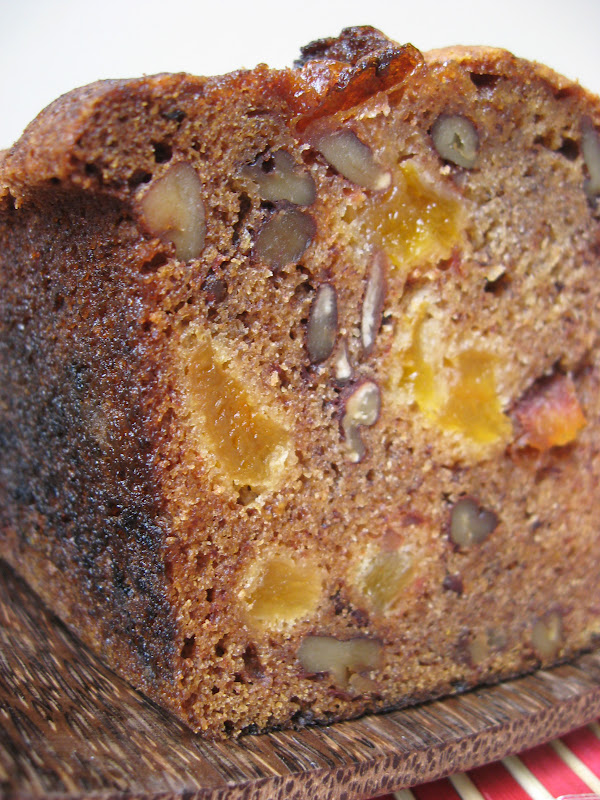
Persimmon & Bourbon Bread (w Pecans & Apricots)
Anna’s adaptation of
David Lebovitz’s version of James Beard’s recipe. Makes one 9-inch loaf.
Ingredients:
1¾ cups sifted flour
1¼ cups sugar
1 teaspoon baking soda
¾ teaspoons salt
½ teaspoon ground nutmeg
1 cup persimmon purée (approx. 2 overly ripe Hachiya persimmons)
½ cup melted unsalted butter
2 large eggs, lightly beaten
1/3 cup bourbon
1 cup pecans, toasted and chopped
1 cup diced dried apricots

Method:


1. Preheat oven to 180’C/350’F degrees.

2. Grease a 9 inch loaf pan. Line the bottom with a piece of baking paper or dust with flour and tap out excess.

3. Sift the first 5 dry ingredients in a large mixing bowl.

4. Make a well in the centre then stir in the butter, eggs, bourbon, persimmon puree then the pecans and apricots.

5. Bake for 1 hour or until toothpick inserted into the centre comes out clean.

Storage:
David says it will keep for about a week at room temperature, if well-wrapped, and can be frozen too. But mine didn't last that long!

Note:
I have a fan forced oven and my bread took about 1 hr and 20 minutes until it was cooked. That really surprised me because usually everything cooks much faster in my oven.
I also used Wild Turkey Honey liqueur as my bourbon.


Persimmons are from the genus Diospyros in the Ebenaceae family along with ebony wood.

They were known to the ancient Greeks as Diospyros, which translates to "the food of the gods". In English they were called Date-Plum, a direct translation from the Persian word “khormaloo”, but these days we call them persimmons, derived from putchamin, pasiminan, or pessamin, (meaning "dry fruit") from Powhatan, a Native American language of the eastern United States.

The Japanese Diospyros kaki is the most widely cultivated species, explaining why the two most known persimmons both have Japanese names.

There are two main types of persimmon: astringent and non-astringent.

Hachiya is the most common astringent persimmon with high levels of soluble tannins which makes the immature fruit bitter. It needs to be fully ripe before consumption.

The fuyu variety is the most common non-astringent persimmon, which can be eaten when firm and not overly ripe.

There is also a little-known third variety, sold only in farmers markets in Japan and prized for its brown flesh.


You can eat persimmons fresh, dried or cooked. To quicken the ripening process, simply store persimmons with apples or bananas and the ethylene emitted from these fruit will speed along the persimmon.

In Asia, sun-dried persimmons are prized and the Japanese version, brought to the US West Coast by Japanese migrants and known as hoshigaki, are growing popular.

The world’s top ten producers, in order of most to least, are China, Korea, Japan, Brazil, Italy, Israel, New Zealand, Iran, Australia and Mexico.

Fresh persimmons are supposedly good for constipation and haemorrhoids, although too many can cause diarrhoea. But no problem, because cooked persimmons are supposedly good for treatig diarrhoea!

Wikipedia explains the “contradictory effect of the raw and cooked fruit is due to its osmotic effect in the raw fruit sugar (causing diarrhea), and the high tannin content of the cooked fruit helping with diarrhea”.

But persimmons do have a dark side. One of the tannins contained in raw persimmons can coagulate in the stomach and form an obstructive mass or bezoar. In fact, 85% of phytobezoars (those of plant origin) are caused by persimmons and more than 90% of persimmon bezoars have to be surgically removed! Gross! There are known epidemics in persimmon growing regions where people consume a lot and it's recommended never to eat persimmons on an empty stomach or, strangely, with crab meat.

This is my contribution to Weekend Herb Blogging, hosted by Susan from The Well-Seasoned Cook. Be sure to see what spring/autumn fare is being cooked up around the world.

Other persimmon recipes:Persimmon Blondies - Vanilla Garlic
Persimmon Chutney - Ambrosia & Nectar
Persimmon Cookies - Pinch My Salt
Persimmon Flan - Christine Cooks
Persimmon Madeleines - Cook & Eat
Persimmon Muffins - From Our (Brazilian) Home to Yours
Persimmon Pavlova Cupcakes - Cupcake Bake Shop
Persimmon Pickles - Rookie Cookery
Persimmon Pomegranate Fruit Salad - Simply Recipes
Persimmon Rice Pudding - Christine Cooks
Persimmon Smoothie w Mint & Lime - Lucullian Delights
Persimmon Spice Cake - What's for Lunch, Honey?
Persimmon Tart - The Kitchn
Persimmon Vinegar - Rookie Cookery
Persimmon, Parsley & Olive Salad - Herbivoracious
Poached Persimmons - White on Rice Couple
Sujeonggwa (Korean persimmon punch) - The Kitchn

Morsels from the Archives:
2006 - Rosewater Cupcakes
2007 - Kingfish Sashimi w Lime / Salmon Sashimi w Ginger Soy
2008 - Grilled Eggplant w Tahini-Yoghurt Dressing

References:
http://www.abc.net.au/gardening/stories/s1952490.htm
http://en.wikipedia.org/wiki/Persimmon
http://www.persimmonsaustralia.com.au/index.html

Sunday, 24 May 2009

feta, sumac & herb salad


I’m back.

I took a bit of time off from blogging. I just wasn’t motivated enough.

I was still cooking up a storm in the kitchen, but I didn’t have the enthusiasm and drive to sit down and write about it.

I sinc received a few concerned emails, and this inspired me that people really are out there reading and I should keep on keeping on.

And so I’m back, with a salad that could equally suit the weather in the cooling southern hemisphere and the warming northern one.

The salad has a slightly Middle Eastern feeling to it and is great even for breakfast with a boiled egg, some freshly sliced tomato and a little hummus and labneh.


Feta, Sumac & Herb Salad
Anna’s very own recipe. Serves 4 as side.

Ingredients:
200g feta, crumbled coarsely
¼ cup finely chopped parsley
4 tablespoons finely chopped coriander
2 tablespoons finely sliced white scallions
1 tablespoon lemon juice
1 teaspoon sumac
Freshly ground black pepper, to taste
Olive oil, to drizzle

Method:

1. Combine all ingredients in a bowl and mix.
2. Drizzle with a little olive oil and serve immediately.


Although I use the term “scallions” on my blog, in my daily life I call those immature onion stalks “shallots”.

I can imagine a few puzzled faces from my blogging friends around the world, wondering if scallions are shallots, then what are shallots?

Yes, yet another confusing mix-up in the English language.

In Australia, there are shallots (increasingly called scallions), there are eschallots (increasing called shallots) and there are spring onions (sometimes called green onions).

Confused yet? I am!

But today I am focusing on scallions, as part of Weekend Herb Blogging.

I love scallions. You can use the whole onion from the white, fiery bulbs to the fresh, green tips. They work well in European, Asian and Middle Eastern cooking and are mild enough to eat raw.

Scallions can come from a wide variety of the Allium genus, wherever there is an under-developed bulb.

The most common species of scallions is Allium fistulosum, often called the Welsh onion.

Shallot and scallion both evolved from the Ancient Greek word “askolonion” which seemed to refer the Philistine town of Ascalon, now Israel’s Ashkelon. This was probably where the Greek’s sourced their scallions, although they were traded from further east.

According to Wikipedia, scallions have many names around the world, many translating into common threads: green, spring, new, small, leafy and young.

Our Weekend Herb Blogging host this week is Cinzia from Cindystar, who currently sports a gorgeous recipe for sciroppo di sambuco (elderflower cordial) on her blog. For those that don’t speak Italian, it’s worth trawling through the silly attempts of Babelfish for the results.


Other interesting scallion recipes include:Claypot Flounder w Ginger & Scallions - No Recipes
Corn, Scallion & Potato Frittata - Serious Eats
Ginger Scallion Chicken - Rasa Malaysia
Honey Scallion Sliders - Not Eating Out in New York
Kale & Olive Oil Mashed Potatoes w Scallions - 101 Cookbooks
Pajeon (Korean scallion pancake) - David Lebovitz
Savoury Cheese & Scallion Scones - Farmgirl Fare
Scallion Bread - Habeas Brûlée
Scallion Mushroom Soup - hey, that tastes good!
Scallion Spread - Beyond Salmon
Sesame Scallion Dumplings - Hugging the Coast
Sweet Potato, Scallion & Sage Risotto - The Lunchbox Bunch
Sweet Scallion Tofu - Book of Yum

Morsels from the Archive:
2008 - Soop Naw Mai (Thai bamboo shoot salad)
2007 - the food of Frankfurt
2006 - Htapodi Stifado (Greek octopus in red wine)

References & onion photo sources
http://www.allotment.org.uk/vegetable/onion-shallot/growing-shallots.php
http://www.maysiesfarm.org/csa/soto/
http://www.harvestwizard.com/2008/05/spring_onions_green_onions_and.html
http://en.wikipedia.org/wiki/Scallion

Sunday, 3 May 2009

italian white bean soup


Served with good crusty bread, this soup makes a quick and simple lunch or a light starter at dinner.

Although I prefer it hot during the autumn and winter, you can easily chill it and serve at a summer barbecue.

Zuppa di Fagioli Cannellini (Italian White Bean Soup)
Anna’s very own recipe. Serves 4 as starter.


Ingredients:

500ml vegetable stock
600g canned cannellini beans
1 white onion, chopped finely
4 garlic cloves, crushed
Juice of 1 lemon
1 tablespoon chopped parsley
¼ cup finely grated parmesan
Pinch of chilli powder
Salt and pepper, to taste
Olive oil, for frying

Method:


1. Heat olive oil in a large pot.

2. Sauté onion and garlic until soft.

3. Add beans, stock, chilli powder and plenty of freshly ground salt and pepper.

4. Bring to the boil and simmer for 10 minutes, uncovered.

5. In a blender, add lemon juice then puree soup to smooth consistency. Taste for seasoning.

6. Eat hot or cold with crusty bread and garnished with olive oil, parsley and parmesan.


Tuesday, 14 April 2009

scallops w lentils, pancetta & sage


I have been eyeing off this recipe ever since my sister gave us this cookbook in March 2007. It was the first dish I marked and one of those I coveted and craved after (hence another Food Challenge), and yet it wasn’t until April 2009 that I finally made it.

Why did it take me so long?

I suppose the recipe seemed complicated and fiddly. Too many ingredients not easily on hand. Too many steps.

But when you break it down it’s pretty easy. Boil in one pot. Fry in another. Done.

Don’t be like me. This recipe is worth the effort. Just make it.

The lentils provide a warm, earthy backdrop to the sweet scallops, crispy sage and salty pancetta. The asparagus brings some fresh flavour while the lemon crème fraîche is an delightful end to the composition. Sublime.

The lentils could easily be made and served without the other accompaniments, as a great vegetarian side dish. I kept some “uncontaminated” from the scallops and served them to Jonas, who has since requested a repeat performance.

One of the wonderful aspects of this dish is the crispy sage leaves. I just adore these leaves fried until brittle and crunchy then paired with anything soft and sweet like fish or pasta.


Scallops w Lentils, Pancetta & Sage

Recipe from Cook with Jamie by Jamie Oliver. Serves 4.

Ingredients:
300g Puy lentils
1 bay leaf
2 cloves garlic, peeled
1 potato, peeled
1 tomato
2 tablespoons flat leaf parsley leaves, finely chopped
2 tablespoons red wine vinegar
4 tablespoons extra virgin olive oil
5 heaped tablespoons crème fraîche (or thick yoghurt)
Juice of 1 lemon
32 baby asparagus spears, woody bases trimmed (or 3-4 large ones)
12 slices pancetta (or smoked, streaky bacon)
12 large scallops (or 16 small scallops)
24 sage leaves
Salt and pepper, to taste
Olive oil, for frying

Method:

1. In a saucepan, combine lentils with garlic cloves, bay leaf, potato and tomato. Cover with water.

2. Bring to the boil and simmer for 20-25 minutes until lentils are tender but holding their shape (ie not mushy).

3. Drain off 90% of the water. Discard the bay leaf.

4. Peel the tomato skin and discard. Return tomato to pot.

5. Mash the tomato, garlic and potato into the lentils with a fork. The lentils actually seem to hold their shape while the mashed vegetables help to create a sauce around the lentils.

6. Add the parsley, red wine vinegar, extra virgin olive oil and salt and pepper to taste. Set aside and keep warmish.

7. Season the crème fraîche with salt and pepper to taste. Add just enough lemon juice to give it a twang. Set aside.

8. Heat a little olive oil in a large non-stick pan then fry pancetta.

9. Once golden and crisp, remove and set aside.

10. Season scallops.

11. In the same frying pan, add asparagus and scallops and cook until scallops are golden on each side and asparagus is tender but still crunchy.

12. Remove from pan and set aside.

13. Finally, add some more olive oil and fry sage leaves for 40 seconds on each side until crispy.

14. Divide lentils between four plates, top each with 8 baby asparagus spears, 3 pancetta slices, 3 large scallops and 6 crispy sage leaves. Serve with a dollop of lemon crème fraîche.


Salvia officinalis
is a common herb that delivers an anything thing but common flavour to your cooking. Not only has it been a medicinal herb for millennia, but it also acts as an ornamental plant with its soft, dusty-green leaves.

In European cooking sage is often served with fatty meats (particularly pork), onions or cheese and can be included in sausages. The classic Italian sage and burnt butter pasta sauce has been popular for decades and in the Balkans sage is used to flavour spirits.

Once upon a time, sage was prescribed for every illness, hence it’s name “salvia” meaning “to heal”. It was used for everything from sprains, fertility, sore throats, swelling, bleeding, snakebites and even to ward away evil. For instance sage, along with thyme, rosemary and lavender was one of the main ingredients of the Four Thieves Vinegar, believed to protect people from the plague.

Modern sciences shows sage to have healing effects as an “anhidrotic, antibiotic, antifungal, astringent, antispasmodic, estrogenic, hypoglycemic, and tonic”.

This recipe is my contribution to Weekend Herb Blogging, this week hosted by Prof. Kitty from wonderfully named blog The Cabinet of Prof. Kitty. Be sure to visit this recap!


Other blogger recipes using sage:

Apricot, Sage & Cornmeal Cookies - Lottie + Doof
Baked White Beans w Tuna & Sage - Mediterranean Cooking in Alaska
Biscuits w Sausage & Sage Gravy - Pinch My Salt
Butternut Squash Cupcakes w Sage Frosting - Vanilla Garlic
Cauliflower w Sage Butter & Eggs - Nami Nami
Chicken Liver & Sage Salad - Dirty Sugar Cookies
Corn Crackers w Rosemary & Sage - Anne'Food
Crispy Sage & Brown Butter Pasta - 80 breakfasts
Fresh Fig & Sage Grilled Pizza - The Left Over Queen
Game Casserole w Cider & Sage - Food, Glorious Food
Guinness Stew w Sage & Ginger - The Hungry Mouse
Pork Chops w Apple, Sage & Pancetta - Closet Cooking
Rabbit Lasagne w Mushrooms & Sage-Scented Bechamel - Food Stories
Roasted Root Vegetables w Maple Sage Glaze - Food Blogga
Sage & Caramelized Onion Risotto Cups - sugarlaws
Sage Focaccia - Baking Bites
Sage Ice Cream - pastry studio
Sage Lady (cocktail) - Yum Sugar
Sage Steamed Snap Beans - Lucullian Delights
Sage, Honey & Pecorino Heart Bread - Ms. Adventures in Italy
Sage-Pecan Pesto - Kalyn's Kitchen
Sage, Pine Nut & Pecorino Scones - Pro Bono Baker
Sage, Walnut & Dried Fig Stuffing - 101 Cookbooks
Savory Sage Corn Cakes - Gluten Free Cooking School
Soothing Chicken & Sage Dumpling Soup - canarygirl.com
Strawberry & Sage Ice Cream - Ice Cream Ireland
Vegetarian Apple-Cider Ginger Sage Gravy - A Veggie Venture
Walnut-Sage Potatoes Au Gratin - Gluten Free Bay
Watercress & Fresh Sage Soup - Chocolate & Zucchini
White Bean, Crème Fraîche & Sage Frittata - Cook Think
Yellow Fin Tuna, Sage Oil, Hibiscus Salt - Wrightfood
Zucchini, Sage & Scamorza Terrine - The Passionate Cook


References:
http://en.wikipedia.org/wiki/Common_sage
http://www.taste.com.au/how+to/articles/1010/sage
http://www.nutrasanus.com/sage.html


Sunday, 12 April 2009

chocolate & pumpkin seed biscuits


These biscuits are what my North American friends would call cookies, so don't get them mixed up with scones, which Americans call biscuits.

Wow. Don't you think it's all very weird how one language can be so confusing?

Regardless of what you call these, you will definately think they're good. So on the chocolate theme: Happy Easter!

 
Chocolate & Pumpkin Seed Biscuits
Recipe by
Stephanie Alexander. Makes 15.
Ingredients:

125g unsalted butter
25g castor sugar
60g soft brown sugar
100g self-raising flour
100g rolled oats
75g dark chocolate (preferably 70%), roughly chopped
50g pepitas (green pumpkin seed kernels)

Method:

1. Preheat oven to 170C. Line a baking tray with baking paper.

2. Cream butter and sugars until light and fluffy. Stir in flour, oats, chocolate and seeds.

3. Place spoonfuls on the baking tray and flatten slightly with the back of a spoon. Leave room for the biscuits to spread. Bake for 15-20 minutes until golden-brown.

4. Cool completely on a rack. Store in an airtight container.


Anna's other chocolate recipes:Drinks
Boozy Hot Chocolate
Spicy Hot Chocolate
Custards & MousseChocolate Chestnut Cake
Chocolate Ricotta Mousse
Muhallabiah Mousse (Iranian white choc & almond pudding)
Strawberry, White Chocolate & Almond Cannoli
Cookies & Slices
Chocolate Coconut Slice
Double Chocolate Cookies
Triple-Choc Brownies
Ice Creams & Candies
Cassata Gelata
Chocolate Raspberry Truffles
Filo Baked Mars Bar
Cakes & Tarts
Apricot & Chocolate Tart
Chocolate Bread & Butter Pudding
Chocolate Chestnut Cake
Fig, Hazelnut & Chocolate Fudge Cake
Fondant au Chocolat Framboise
Ginger Cake w Chocolate Sauce
Glacé Apricot, Chocolate & Poppy Seed Cupcakes
Ludo's Chocolate Truffle Tart
Ricotta, Strawberry & Choc-Chip Muffins
Schwarzwälderkirschtorte (black forest cake)


Tuesday, 7 April 2009

pozole verde: mexican stew


At first this soup seems mild, almost bland and disappointing, but as you continue to eat, it becomes moreish and intoxicating. We made a huge batch and between three of us we devoured the entire pot within minutes, greedily going back for seconds and thirds.

Afterwards we all agreed that the first mouthful seemed dull but the last mouthful left us wanting still more. It had a ravenous effect on all of us and we declared the recipe a delicious success. A triumph!

Cooking this pozole also fulfilled two 2009 Food Challenge by ticking off yet another Mexican recipe (one of the cuisines I have set out to explore this year) and also cooking with hominy.

Pozole Verde (Hominy, Tomatillo & Pepita Stew)
Variation on recipe by Serious Eats. Serves 3 – 4.
Ingredients:
800g can hominy
800ml canned tomatillos (green tomatoes)
1 cup raw hulled pumpkin seeds (pepitas)
2 serrano chillies, finely chopped
2 tablespoons chopped white onion
½ cup chopped fresh coriander
¼ cup vegetable stock
1 teaspoon salt
3 radishes, thinly sliced
2 teaspoons dried epazote (or oregano)
2 limes, cut into wedges
Method:
1. Dry toast the pumpkin seeds in a large skillet over medium high heat. Cook, stirring occasionally until seeds are lightly browned. Remove and let cool for a minute. Then grind in a food processor or blender. Set aside.
2. In a blender add the tomatillos, coriander, chillies, salt, onion and stock. Process until smooth.
3. Heat the tomatillo mixture in a large pot. Sprinkle in the ground pumpkin seeds. Stir constantly until mixture has thickened, around 7 minutes.
4. Add the hominy along with its liquid. Bring to a boil and then let simmer for 30 minutes.
5. When the hominy is tender, season to taste. Ladle soup into bowls and top with radishes, a sprinkling of epazote and a squeeze of lime juice.


Hominy, also known as nixtamal, is dried corn kernels which have been treated with an alkali, a process known as nixtamalisation.

In Mexico people use lime-water (calcium hydroxide) and in the US wood ash was used to create lye-water (sodium hydroxide or potassium hydroxide solution). The process removed the germ and the hard outer hull from the kernels, allowing easier digestion.

The process also changes the nutritional value of the corn, allowing the body to more easily absorb certain nutrients such as Vitamin B, amino acids, calcium and phosphorus.

Nixtamalisation was used as early as 1500 BCE in Guatemala. The fact that the kernels were dried meant they could be soaked and processed any time and many native people in Central and North America relied on hominy as an integral food source.

Hominy is my theme ingredient for Weekend Herb Blogging, this week hosted by Chriesi from Almond Corner.

References:
http://en.wikipedia.org/wiki/Hominy
http://en.wikipedia.org/wiki/File:Hominy_(maize).JPG

Sunday, 5 April 2009

earth hour recap

More than 4000 cities and towns in 88 countries participated in Earth Hour, making it the world's largest ever demonstration of public concern about climate change. I can't even think of any other (peaceful) event where so many people round the world have been involved.

It’s not surprising that even with the small number of blogging event participants we had two Greek bloggers. Why? Because Greece had an amazing rate of participation. Although the Philippines had the most cities/towns/municipalities participating (600+), Greece came second (400+), then Australia (300+), Canada (300+) and the USA (200+).

Earth Hour is misunderstood by a lot of people, who think the focus in on energy saving. WWF and Earth Hour participants around the world are not stupid – they know that turning off lights for one hour doesn’t save enough electricity to make a difference.

Earth Hour was never about one hour.

Earth Hour has two very important roles to play in public awareness:
1) It shows us - in a visible, practical way - that when many individuals do something together it does make a difference. When we all switched off our lights and made our cities go dark, we saw that if each of us does our bit (individuals and business) it will make a difference overall. It is symbolic.
2) By participating in Earth Hour, people walk around their homes switching off appliances and lights etc and through this practical process they realise where they can reduce their energy consumption (and costs) every day. And that experience is what can lead to a lasting change.

Participating in Earth Hour is an educational exercise. It is not a saviour in itself and for media and critics to use this as the main reason to condemn Earth Hour, well they are just showing their ignorance and lack of imagination.

Anyway, that’s my take on it, and since I worked on the Australian project and speak on a daily basis to one of Earth Hour’s founders, I'm confident I know what I’m talking about :)

But onto the recap!

Firstly, thanks to the 10 bloggers who joined me for this event. I must admit even I found it hard to choose a recipe that was environmentally friendly enough to feel confident writing about it. The food global supply chain is so massive that it’s often hard to find local ingredients or low level packaging. It’s a real challenge.

So here are the results:


Arugula White Bean Dip
Bellini Valli
from More Than Burnt Toast (British Columbia, Canada) made an Earth Hour meal that that could be enjoyed by candlelight but which lefts only a small carbon imprint on her area of the world. Her bean dip requires no cooking, the rocket was bought from a local greenhouse and the naan bread came from a local bakery too.


Mustard Greens
Johanna
from Food Junkie not Junk Food (Athens, Greece) made a dish with vegetables directly from her own garden! Mustard greens are wonderful, vibrantly flavoured vegetables that I wish I could find more easily in Sydney. If only I had my own garden to grow them in!

Chicken Curry w Tomatoes
Deeba from Passionate About Baking (Gurgaon, India) used local farm raised chicken, fresh tomatoes and fresh curry leaves from her own curry tree to produce this delicious curry. There was no packaging involved and all the ingredients were locally sourced.


Cypriot Mezedes
Ivy
from Kopiaste.. to Greek Hospitality (Greece) choose recipes that did not need to be cooked to reduce her energy consumption. Her mezedes included taramosalata, tahini, horiatiki, tzatziki and a bottle of Cypriot wine by candle light. I’m swooning!


Barley Salad w Peppers, Beans & Everything Else
Soma
from eCurry (Plano, Texas, USA) made a trip to the local market to load up on fresh, seasonal vegetables, beans and grains to make this “healthy and fulfilling salad”.


Banana Peach Mango Crumble
Chris
from Mele Cotte (Atlanta, GA, USA) went sweet on fresh fruit to eliminate packaging and conjured up this “quick and satisfying dessert”. Best of all she can recycle her fruit rinds and in the compost!


Pasta in Home Made Sun-Dried Tomato Sauce
Sandeepa from Bong Mom's CookBook (USA) used local ingredients to make her dish, which also uses few ingredients, limiting waste from leftovers that might not be used.


Carrot & Tomato Soup
Rinku from Cooking in Westchester (Westchester, NY, USA) relied on local produce for her key ingredients. The recipe can be made in bulk in season then frozen for later use.


Spaghetti w Homemade Pesto
Hema
from Simply Spices (USA) didn't throw away some week-old basil, but instead turned it into pesto to flavour pasta. An economical and resourceful use of aging, yet still perfectly delicious, herbs.

Beef Stew w Fresh Casserole Herbs
Iska
from ISKAndals.com (New Zealand) used home-grown herbs, veggies from the farmer's market and 100% local beef which she explains "means the meat came from cows born and raised on NZ farms, produced according to the NZ' animal welfare codes, low in foodmiles and free from added growth hormones".

Potato & Feta Cakes w Two Toppings
This was my own contribution to low-carbon cooking, using leftovers from various meals to make a dish that could stand alone in its own right. It was truly delicious.

So that's it folks. For more information about low-carbon cooking, I included some facts and tips in my recipe post.

Otherwise check out all the videos and photos of Earth Hour around the world.

Thanks for participating.

Related Posts with Thumbnails