Monday, 11 September 2006

five years ago

Five years ago today.

Jonas and I were watching The West Wing when the broadcast was interrupted with news of the first plane. We sat there watching, horrified, shocked, captivated.

This day did change the world: a loud roar in some countries and a whisper in others.

As an Australian, I was not entirely shocked that people felt this way about the US, and that they would go this far to express it, but I was shocked to see it occur step by step.

As an American (yes, I am a dual national) I felt sad that this could happen, that the country could be hated so much, and that so many innocent people died in such a horrible way.

As a former NYC resident (albeit, only for four months) I was terrified for all my friends and family and was one of the zillions of people jamming NY phone lines trying to get word that they were OK.

As a Westerner, I felt frightened that my own urban habitat was under attack. It showed me that we can no longer be complacent about the terrible things that happen to people all over the world. We had been cushioned by our affluence, but now I understood that if the world is unhappy, we will eventually feel it too.

Without turning my gastronomic blog into a political one, I really believe that this day, in many ways, ended the West’s ignorant bliss.

It's more than tragic that so many people had to die in order for us to understand this.

Tags:

Saturday, 9 September 2006

vote one - mangosteen

This weekend my Weekend Herb Blogging post is not a recipe. It’s about a wonderful, beautiful fruit that I recently discovered. It's so fantastic that I want to share it with all the world.

Last weekend I made my weekly pilgrimage to my favourite provedore/green grocer to see what yummy treats they had in store for me this week.

Sitting in the fruit aisles, looking strange and dark sat a pile of mangosteens, individually wrapped in styrofoam stockings to protect their precious cargo. With some helpful guidance from my grocer I selected a few fruits for A$1.30 each (US98c / EU77c) and took them home to try.

I AM IN LOVE!

Mangosteens could just possibly be the best fruit in the whole world.

They could just possibly be the best food in the whole world.

Yes, this is a huge call but then I have fallen hard for these tropical fruits. Il Presidente Mangosteen. Vote one mangosteen!

I feel so entirely blessed that farmers in Far North Queensland decided that their tropical plots would be ideal for these wonderful little fruits and so they started growing them back in the 1990s. Since a mangosteen tree can take around 10 years to bear fruit, this forethought has meant that Australians are now starting to enjoy some of the most delectable fruits that are rarely found outside South East Asia. Yay!

I urge anyone who can get their hands on a mangosteen to give it a try. You will not be disappointed.

The exterior shell of the fruit, known as the pericap, turns a deep, bold red when it is ripe. When first picked from the tree, the outer casing is soft and can be squeezed open but usually people buy the fruit a few days later and so the pericap has dried and hardened so probably needs to be opened with a knife.

The inside of the mangosteen is bright white and comes in segments, much like a mandarin. There are conflicting views as to whether the small seeds within the mangosteen are edible. My greengrocer told me that I can eat them if they're soft, but if it’s too hard I should spit them out. Thus far I’ve only come across soft seeds that can be chewed and so I’ve eaten them without any nasty side effects.

Mangosteens have a wonderful creamy texture with a glorious sweet and refreshing flavour. They are similar to lychees, but the lychee seems much coarser compared to the elegant lemon-floral taste of the mangosteen. It is also reminiscent of fragrant peaches and white grapes, with its perfect balance of acidity and sweetness.

Bliss!!!

The mangosteen is an evergreen tree that originates in the archipelago making up Malaysia and Indonesia. French explorer Jacques Garcin (1673-1751) gave it the scientific name Garcinia mangostana.

Mangosteens trees grow around 7 – 25 metres tall (23 – 82 feet) and can only grow in tropical climates. Exposure to temperatures below 4’C (40’F) would kill a mature plant! For this reason they can only be grown in locations like South East Asia, Central Africa, Hawaii, far northern Queensland (Australia), Central America and the Caribbean. Even attempts to grow mangosteens in humid Florida have been problematic.

Unfortunately for Americans, fresh mangosteens cannot be imported into the US from most of these locations due to the fear of the Asian fruit fly hitching a ride with them. Even those grown in Hawaii cannot be transported to the mainland and many mangosteens found in the Chinatowns of US cities come illegally from Canada. The US can import mangosteens from 18 Caribbean countries but most of these countries don’t cultivate mangosteens commercially. Good news for the US however, since new crops in Puerto Rico have reach maturity and fresh mangosteens are slowly entering markets.

In Europe, mangosteens can be found in green grocers, usually with Asian specialties, as well as certain farmers markets. I am led to believe they are still quite rare however.

In its home of South East Asia it is known as the “Queen of Fruits” while the durian, the world’s most infamously pungent fruit, is known as the “King”. In the French Caribbean, mangosteens are known as “the food of the Gods”.

Juice from the dark red pericap is so potent that it can be impossible to remove. This has led some hotels in South East Asia to ban mangosteens from their premises.

Other plants in the mangosteen family, such as St John’s Wort, have been used for medicinal purposes and scientists and researchers are studying mangosteens (both the fruit and the pericap) to develop products such as antimicrobial and antiparasitic treatments; dehydration aids; antiseptics and anti-inflammatories.

The pericap of the mangosteens contains mangostin, which is an organic compound made up of xanthones. The xanthones in mangosteens are some of the strongest anti-radicals, anti-oxigenes, anti-aging agents and anti-cancerogenes to be found organically.

Filipinos use a mangosteen extract to control fever and in India the pericap is believed to assist dysentery and infectious diarrhoea.

In China and Thailand they utilise mangosteens for treating wounds, malaria, gonorrhoea, urinary tract infections, tuberculosis and syphilis.

In the Caribbean, the mangosteen tea "eau de Creole", is believed to be a tonic for fatigue, while Brazilians use mangosteen tea for digestion and in Venezuela it’s included in a poultice for skin infections caused by parasites.
I feel guilty for not providing a WHB recipe and so I found this recipe for a sorbet on the Cape Trib Exotic Fruit Farm website. Mangosteen sorbet would be heavenly, but I still believe nothing could beat the sweet, creaminess of the fresh fruit.

Mangosteen Sorbet
Recipe by Cape Trib Exotic Fruit Farm.
Ingredients:

1 cup of chopped mangosteen segments
1 cup of dry champagne
2 egg whites
3 tablespoons of sugar
6 lime slices
Method:
1. Peel the mangosteen and chop the fruit, then push the flesh through a fine sieve to extract the puree.
2. Stir the champagne into the puree.
3. Whip the egg whites, mix in the sugar, and then fold the mixture into the fruit puree and freeze.
4. Decorate with lime slices before serving.

Be sure to check out the WHB recap at Kalyn’s Kitchen. There are so many interesting recipes and ideas that come out of the group.

References
http://www.xango.net
http://www.mangosteen.com
http://www.usenature.com/xango.htm
http://www.capetrib.com.au
http://www.nytimes.com/2006/08/09/dining/09mang.html?ex=1157860800&en=ca93e777f32dfcb5&ei=5070

Tags:

Friday, 8 September 2006

recipe road test - tangelo caprioska

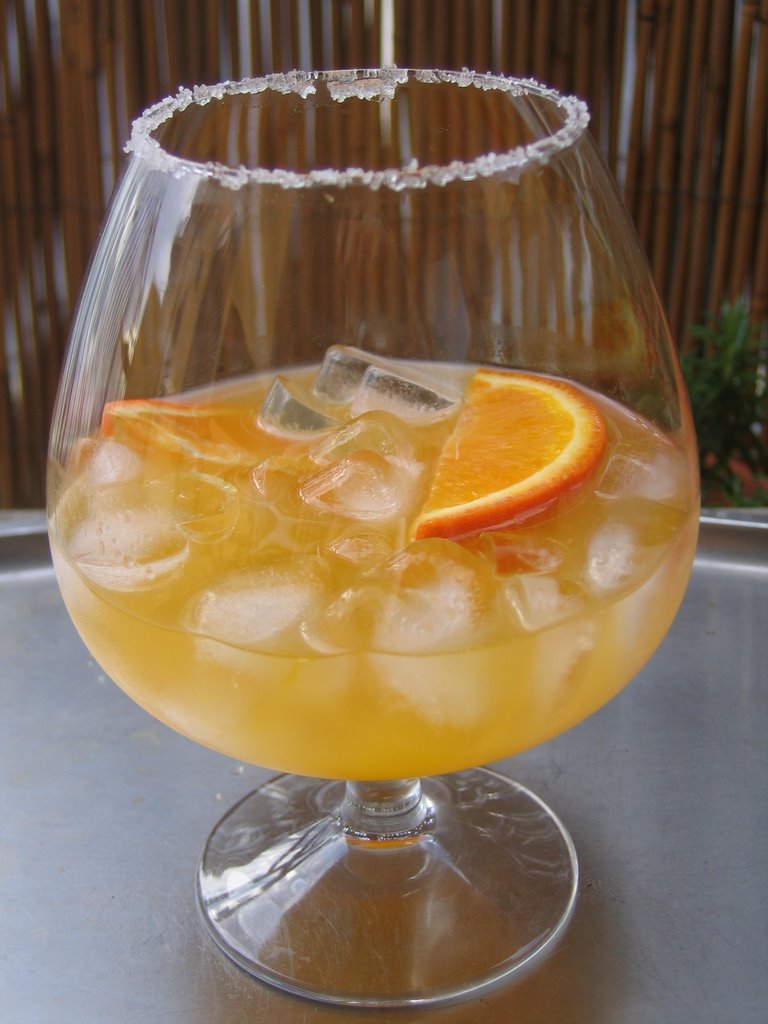
In honour of Haalo's Friday o'clock Swill, I decided to road test her tangelo caprioska.

This recipe is easy and delicious.

I thoroughly recommend it, although I do warn you they are very easy to drink so you may find yourself chugging down a few before realising the adverse effects!

Tangelo Caprioska
Recipe by Haalo at Cook (almost) Anything At Least Once. Makes 1.
Ingredients:
1 tangelo, cut into 16 pieces
1 tablespoon sugar
60ml lemon vodka
1 tablespoon sugar syrup
ice cubes
Method:
1. Muddle most of the tangelo pieces with the sugar. Strain.
2. Place a handful of ice in the shaker add strained tangelo juice, vodka and sugar syrup. Shake well.
3. In a sugar rimmed glass, filled half with ice, add the shaken ingredients.
4. Garnish with the set-aside tangelo pieces.

Anna's variations: None! This recipe was brilliant just as it was. I used heart shaped ice cubes, homemade sugar syrup and Absolut Citron and I adored the final product.


Tags:

Wednesday, 6 September 2006

sydney fish markets


Ever seen sea urchins, barramundi, moreton bay bugs, periwinkles or jumbo Tasmanian oysters bigger than your hand? Then check out my photos of the Sydney Fish Markets.
Sydney Fish Market
Bank Street, Pyrmont
http://www.sydneyfishmarket.com.au
Open every day from 7:00am (except Christmas)
Tours available 6:55am Thursdays (A$20 entry)

According to their website, the Sydney Fish Market:
- Is the largest market of its kind in the Southern Hemisphere
- Receives over two million local and international visitors annually
- Has more species of seafood on offer than any other market in the world outside Japan
- Auctions over 100 species of familiar and exotic varieties on any day
- Sells an average of 2,700 crates, or 50 tonnes of seafood every day
- Has a seafood school that attracts over 14,000 students per year

Tuesday, 5 September 2006

recipe carousel #12 - fruit in savoury food

I know, I am very remiss. It's Tuesday night and I've only just posted "Monday's" Recipe Carousel.

I don't really have a good excuse. On Sunday evening I cuddled up to Jonas because he finally had a night off work and then on Monday evening I came home drunk as a skunk at 6:30pm after some pretty hefty cocktails with work colleagues.

Margarita Monday? Hmmm.

Apologies to those people that may have tuned in on Monday only to find Recipe Carousel missing. ~That's assuming that anyone is tuning in at all!~

This week is the beginning of spring here in Sydney. Over the weekend we had bright blue skies, sunny weather and a delightful warm wind. It was hot enough for me to feel sweaty in a t-shirt and skirt and so I was delighted.

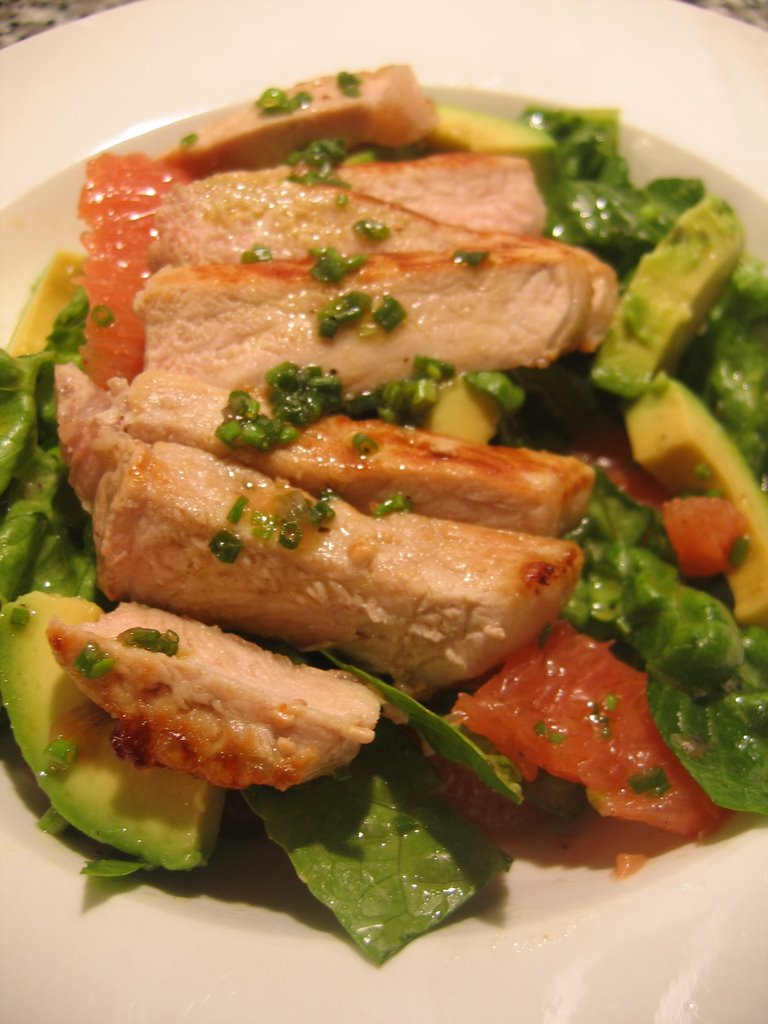
In honour of this weather I cooked a Pork, Ruby Grapefruit & Avocado Salad with Chive Vinaigrette and so this inspired me to consider a Recipe Carousel theme of fruit in savoury food.

Next Recipe Carousel I plan to give you seven strange recipes using vegetables in desserts, so make sure you check in next week for that.

So without further ado, our seven fruit in savoury food recipes are . . .

Strawberry Salsa is a roaring red recipe from Anne in Sweden (Anne's Food). She uses strawberries, lemons, onions, parlsey and cayenne pepper to create a summer salsa to accompany grilled food. I can imagine this would be very popular at a BBQ. Photo courtesy of Anne.


Pear & Sage Stuffed Chicken looks wonderful and is the creation of Johanna in the UK (The Passionate Cook). The chicken is filled with pear and fresh sage and then coated in a hazelnut crust before being fried to crispy perfection. Johanna recommends serving this with a lambs lettuce and crispy bacon salad and mash potatoes with pumpkin seed oil. Sounds good to me! Photo courtesy of Johanna.


Banana Coconut Dip is one of many international recipes from SC in the USA (Curiosity Killed the Cook). SC developed a list of every country in the world and is systematically cooking a recipe from each one. This dip, which is also known as Fa'alifu Fa'I, comes from American Samoa and SC claims it is delicious. Photo courtesy of SC.


Grilled Peaches & Pork Salad comes from Joe in the USA (Culinary in the Desert). Joe uses pork loin chops and flavours his salad with balsamic vinegar, lime juice and thyme. The peaches used need to be firm because they are grilled until brown. Photo courtesy of Joe.


Pineapple Pulisseri is an interesting contribution from Inji in India (Ginger and Mango). Semi-ripe pineapple is combined with chilli, coconut, spices, tomatoes and Indian style curd (I'm wondering if this is paneer?). It sounds delightfully sweet and sour all at once and I hope to try this recipe out soon. Photo courtesy of Inji.


Fruity Channa Salad comes from Sailu in India (Sailu's Food) and despite the significant amount of fruit involved, this is a savoury dish flavoured with pepper, chickpeas and onions, as well as honey and cucumber. It seems light and refreshing and Sailu says it's nutritious as well. I'm sold! Photo courtesy of Sailu.


Blueberry & Arugula Salad is an elegant salad option from Katerina in Canada (Daily Unadventures in Cooking). The salad contains walnuts, goats cheese, cherry tomatoes and, of course, blueberries and the dressing is flavoured with blueberry juice, manuka honey and cider vinegar. Photo courtesy of Katerina.

Add your own recipe!
If you want to link in your own "fruit in savoury food" recipe and share the love around, just leave the link in the comments section. You didn’t have to invent the recipe yourself, just make it and post it on your site. The whole idea of Recipe Carousel is that good recipes are shared with people who love to cook.
Note: Usual comments are more than welcome but all html links must be recipe related (yours or others).

Check out other Recipe Carousel themes: made from scratch, strawberries, jam, bread, seafood mains, ice cream, soup, chocolate and drinks.

Also, on another note this is my 100th post. Yippee!!!

Tags:

Saturday, 2 September 2006

wooing grapefruit with chives

For Christmas last year my sister, Jo, bought me the Australian Gourmet Traveller ‘Modern Salads’ cookbook. It was a perfect gift, providing endless ideas for one of my favourite meals: salad.

I particularly love salads that include meats or fish, like tuna nicoise and yum nua (Thai beef salad).

One of the recipes I discovered in this book was a salad for pork with ruby grapefruit and avocado, which included an easy but interesting chive dressing.

Grapefruit is one of those things that I have tried again and again over the years. I keep on keeping on in the hope that one day my tastebuds will miraculously accept the flavour.

Gorgonzola, red wine, oysters, caviar and eel have all made it onto my menu through sheer determination. Capsicum, brussel sprouts, couscous, pumpkin and grapefruit are still out in the cold. In the wise words of a Kings Cross karaoke bar menu “basically it is not to be”.

Caramelised, grilled, sprinkled with sugar, frozen, in cocktails – all to no avail – but through this recipe I think I’ve found a way to make grapefruit palatable and potentially trick my tastebuds into a lifelong friendship.

But grapefruit it not actually my ingredient of focus for this Weekend Herb Blogging, hosted by Genie from The Inadvertent Gardener. Today it’s all about chives.

Let it be said that I love chives. They taste like herbs and onions rolled into one. Full of punch but verdant and healthy.

After the recipe, check out some of the interesting information I uncovered on chives through the internet.
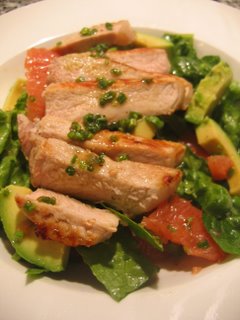
Pork, Ruby Grapefruit & Avocado Salad w Chive Vinaigrette
Based on a recipe from Australian Gourmet Traveller ‘Modern Salads’. Serves 4 as a light meal.
Ingredients:
4 pork cutlets
2 ruby grapefruit, peeled
2 baby cos lettuce
2 avocadoes
Chive Vinaigrette
1 teaspoons Dijon mustard
2 teaspoons sherry vinegar
1 tablespoon reserved ruby grapefruit juice
1/3 cup olive oil
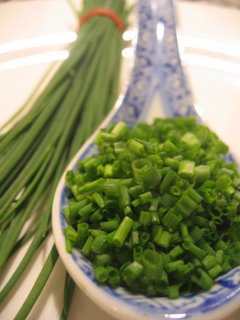
¼ cup finely chopped chives (approx. 1 bunch)
Method:
1. Separate and cut baby cos leaves into 1cm thick slices. Wash and drain.
2. Segment grapefruit over a bowl to catch juices (find the white veins between each segment and cut on either side to separate crescent shaped slices).
3. Cut each avocado in half and remove the seeds. Take one half and slide a spoon between the flesh and the skin to remove the flesh. Slice into rounds and then cut in half again.
4. For chive vinaigrette, combine Dijon, vinegar and grapefruit juice in a bowl then gradually whisk in olive oil until emulsified. Season to taste and stir in chives just before serving.
5. Fry pork cutlets until cooked through. Remove from heat and allow to rest for 2 minutes. Slice into strips.
6. Combine baby cos, grapefruit segments, pork and dressing. Add avocado, stir gently and then serve.
Variation: Gourmet Traveller’s original recipe uses crumbed pork (schnitzel).

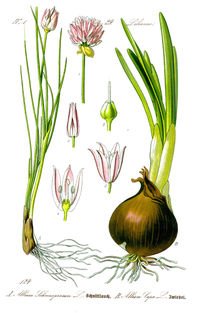
Chives (Allium schoenoprasum) are bulb-forming herbaceous perennials that grow in clumps. Their leaves are firm, straight and hollow while the flowers are star-shaped globe clusters and range from deep purple to pink. I never imagined just how beautiful these flowers can be! Photo of chive flower from Wikipedia.Chives belong to the same family as onions, leeks, and garlic (Alliaceae) and are the only species of Allium native to both the New and the Old World – which means they must be pretty old.
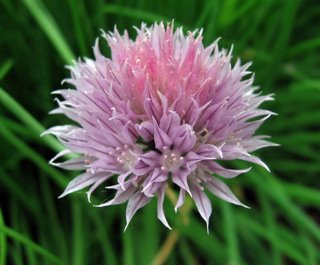
The name chive comes from a French word “cive” which in turn derived from the Latin “cepa” meaning onion. Since chives grow in big clumps, they’re mostly referred to in plural form.

The species name for chives, schoenoprasum, comes from the Greek words skhoinos (sedge) and prason (onion).

Records show chives have been cultivated in Europe since the Middle Ages and by the sixteenth century they were common plants in herb gardens throughout Europe

Chives are gastronomically used all over the world. In Sweden they are particularly loved and in French cuisine they are considered one of the “fine herbs” along with tarragon, chervil and parsley. Chives are commonly paired with fish, eggs, potatoes, butter, cream and soups.

Chives have limited use as a medicinal herb because it has many of the same properties as garlic, only in much milder quantities. At the same time, negative reactions to chives are rarely encountered, although overeating can cause indigestion (but what doesn’t when you eat too much).Due to sulphuric properties, chives have insect-repelling properties. The juice of the leaves can also be used for fighting fungal infections, mildew and scab. Although it is an insect repellent, its flowers are very attractive to bees and are used in gardens where many plants need pollination. Chive sketch (above) comes from Wikipedia.

Chives thrive in well drained, slightly acidic soil that’s rich in organic matter and moisture. They require full sun and can be grown from seeds in early spring or by cutting clumps from the outer edges of an established patch and transplanting.

In winter, chives die back and new leaves appear in early spring. The flowers bloom for two months around midsummer and need to be removed if you want further production of the green leaves for eating. Apparently the flowers are popular used in dried ornamental bouquets.

When harvesting chives, snip them with scissors 5cm (2in) above the ground. It will take a while for them to grow back so make sure you don’t cut away the whole clump at once.

All leaves should be cut fairly regularly to produce further growth and remove tough leaves. It’s interesting to know that any new leaf growth will be quite tender.

So have a look at the other Weekend Herb Blogging taking place this weekend at Genie's recap.

On another note, today is the seventh birthday of my Spiderman-loving nephew Matthew. He's a sweet boy with the most charming smile that would melt any heart. He's great at sharing his candy as well as handing out headbutts. I love that little arachnophile.

Happy birthday!

References
http://en.wikipedia.org/wiki/Chives
http://www.gardenguides.com/herbs/chives.htm
http://www.ces.ncsu.edu/depts/hort/hil/hil-124.html

Friday, 1 September 2006

sweeten up with lindt

Lindt Concept Store
53 Martin Place, Sydney
T: +61 2 8257 1600
E: au-cafeorders@lindt.com

Sydney, Australia is the site of the world’s first Lindt Concept Store. No, it's not a new thing. It was opening in late 2004 so I'm a little slow to write about this one. But since there's no other Lindt store in the world (yet) I thought I'd blog about it at this late stage anyway.

Why Australia? Apparently the wonderful people at Lindt & Sprüngli were happy that sales in Australia had grown ten fold in the seven years since they started selling their products here. This prompted them to use Australia as their testing ground.

Well something worked because now they’re opening new Lindt stores in other locations around Asia (has anyone heard the exact locations?).

In the meantime, I wanted to share with you some of the yummy treats I have devoured from Lindt’s only store.

St Moritz
Layers of almond cake, milk chocolate mousse, white chocolate mousse and covered with shaved chocolate.

70% Excellence Tart
Shortcrust pastry holds a pool of dark ganache made with Lindt's 70% cocoa.

Poire Caramel
A centre of caramelised pear and caramel mousse on top of a dark chocolate cake, all encased in milk chocolate mousse.

Orange Chocolate
Almond and orange cake soaked in Grand Mariner and layered with milk chocolate mousse. Covered with dark chocolate glaze.
Pistachio Berry Dacquoise
Layers of berry compote, coconut sponge and a white chocolate and pistachio ganache. They also make chocolate sablés, Florentines, éclairs, brownies and mud cake.

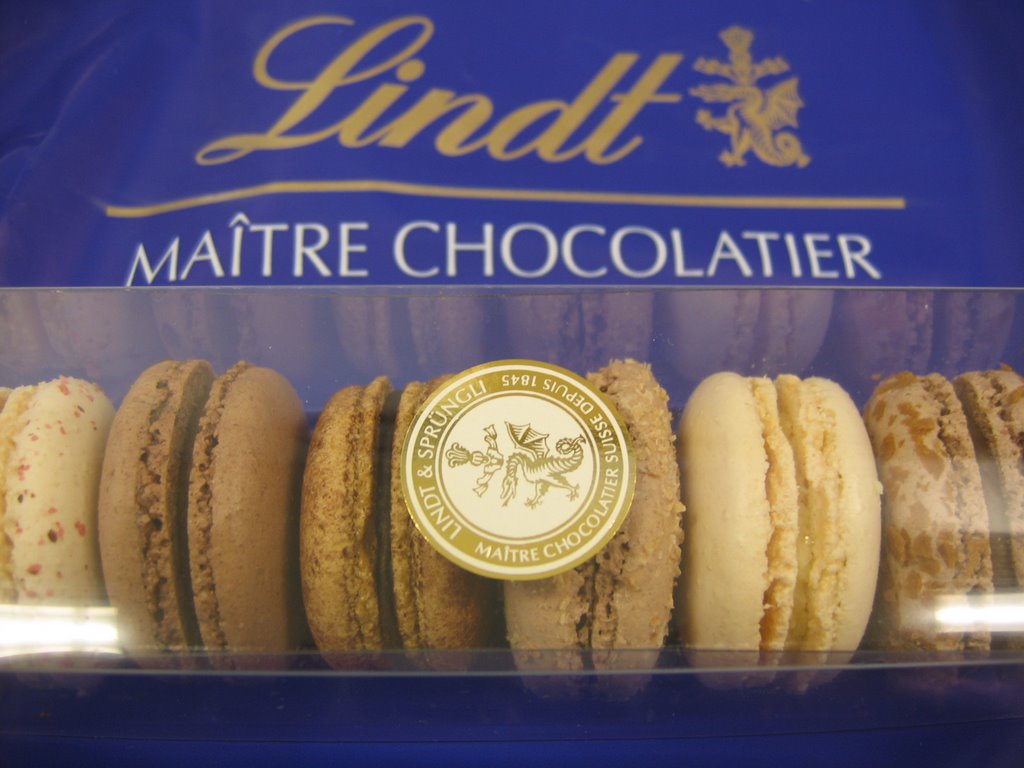
Delice are Lindt's macaroons. I have to say they range in quality because sometimes they are quite chewy and then on other occassions they are exquisitely perfect and I could devour thousands on end.
I can’t decide which one I like best, but I’m pretty torn between the classic and delicious champagne and the rich, bittersweet choc-orange that laced with coconut. Although the strawberry delice is very dainty, sprinkled with crystallised lilacs.
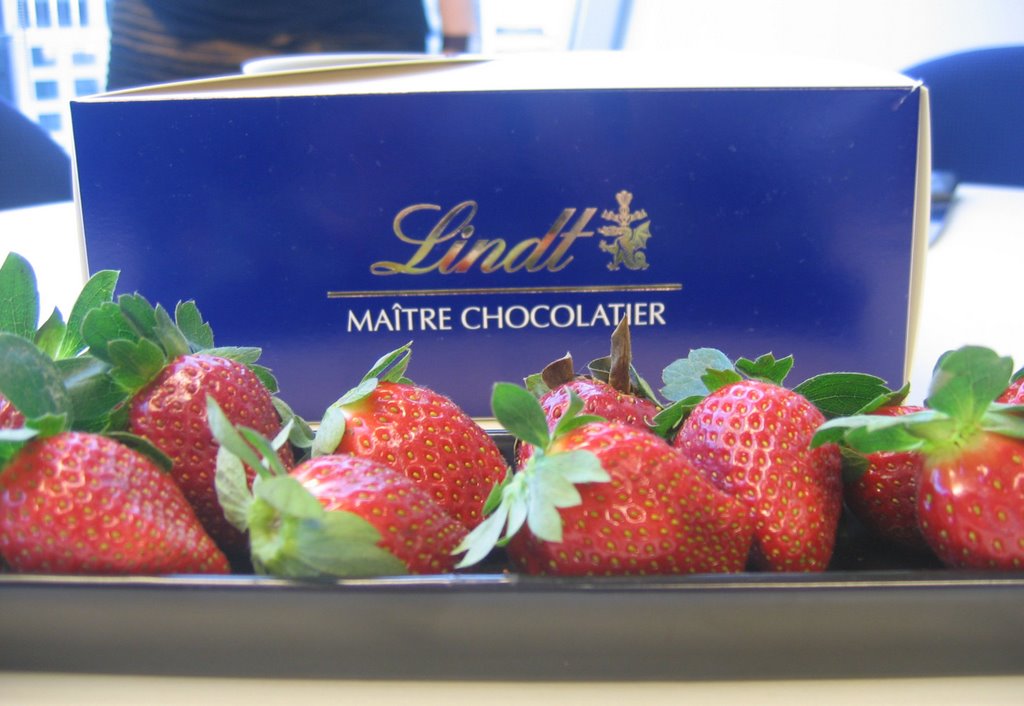
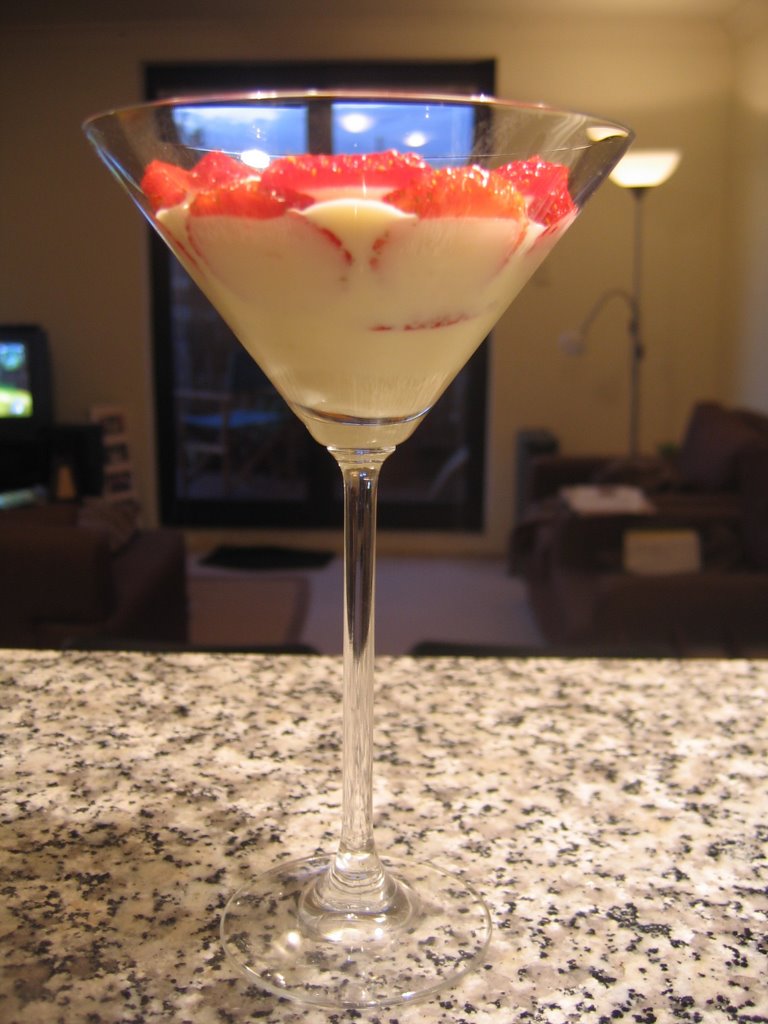
Apart from the above, they have the usual artisan chocolates that most good chocolatiers would offer.

The other wonderful thing to mention is the interesting Lindt chocolate blocks they import from Europe (mostly Switzerland or Germany since the packages are still in German). They have some very imaginative and seasonal flavours that don’t hit Australian shelves, such as Poire Intense (dark chocolate with almond slivers and candied pear pieces), rhubarb & strawberry or passionfruit & yoghurt. Divine!

If you’re in Sydney, duck into the Lindt Concept Store for a sweet afternoon snack and some takeaway blocks for the weekend nibbles!!

Wednesday, 30 August 2006

goats' milk yoghurt & ginger honey fool

On a trip to the markets, Jonas and I came home with two very exciting finds.

Firstly, we bought a jar of ginger honey straight from the beekeeper from Pride of Oak. The honey was runny, liquid gold and our friendly beekeeper had steeped chunks of fresh ginger into the jar before sealing it. The flavour was divine.

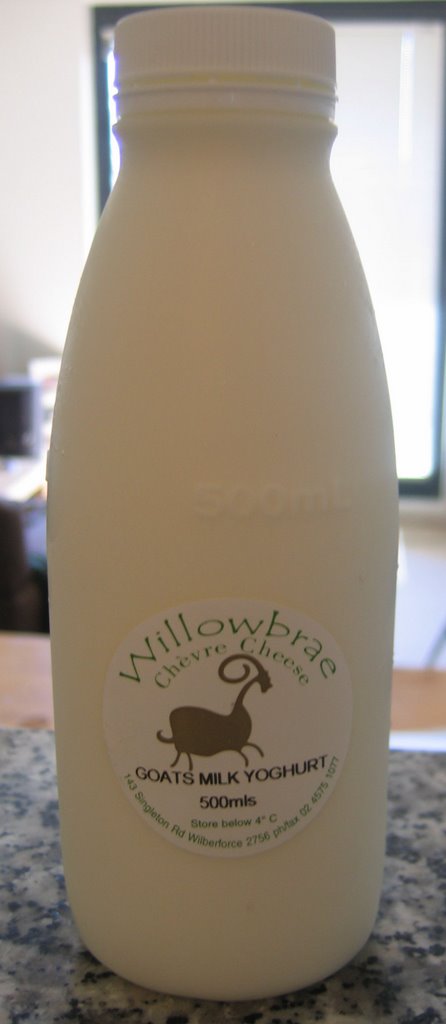
Our second treasure was Willowbrae goat's yoghurt. I first discovered Willowbrae at the Sydney Specialist Cheese Show in May this year. They are a small goat farm in the Hawkesbury who hand milk their 100 goats daily to produce some of the most delicious curds, yoghurts and soft chevre cheese.

I’m a huge fan of goat's cheese so I thought I should take the next step and try the yoghurt. It was very pungent and tasted very much like goats’ cheese. Not for the faint hearted!

Immediately upon tasting it, I thought the yoghurt would make an excellent and unique dessert.

And what perfect timing for my first entry to Jihvā For Ingredients (JFI), a monthly blogging voyage to find a gastronomic zen using a theme ingredient.

In the words of Indira from Mahanandi, who first started this event:
What is Jihvā ?
Jihvā, the Sanskrit word means taste, desire and deep longing. This powerful word also represents tongue and taste buds.
What is Jihvā for Ingredients?

I believe for Jihvā to happen, it’s all in the ingredients and how they are cooked. Jihvā for Ingredients (JFI) is online monthly food event, celebrating the ingredients and what they can do for our Jihvā.

This month the JFI host is Vineela from Vineela’s Cuisine and she has chosen “Milk and Milk Products” as her theme ingredient.

When I first started blogging I noticed there was a proliferation of food blogs in the USA, but once I started delving into English language blogs I discovered that Indians are fanatic foodies!

India’s abundant variety of fresh vegetables, fruits, herbs and spices lends itself easily to so much diverse cooking ingredients and styles. From an Australian perspective, so many Indian ingredients are rare and the recipe outcomes are utterly amazing.

I love the idea of taking part in JFI because it was originally an Indian inspired event that has become global. Now I have the opportunity to learn some of the amazing and regionally diverse cooking styles from India and all over the world!

¿What was life like before the internet?

My contribution to my very first JFI is my own little invention inspired by my market purchases: Goat's Milk Yoghurt & Ginger Honey Fool.

This led me to wonder: where did the name “fool” come from? It’s a strange name for a dessert, but then “trifle” has similar connotations. If internet search engine results are to be believed, this dessert was called a fool because it’s light and not overly substantial. Just like the trifle.

I was nervous about my flavour combination, but it turned out to be totally delicious. The goat's milk yoghurt was tangy and the ginger honey evened it out beautifully. I recommend this highly as a light, summer dessert.

Goat's Milk Yoghurt & Ginger Honey Fool
Anna’s very own recipe. Serves 4.
Ingredients:
250ml (1 cup) goat's milk yoghurt
190ml (¾ cup) thickened cream
60g (¼ cup) superfine caster sugar
2 tablespoons ginger honey*
Fruit to serve
Method:
1. Over a medium heat, stir sugar and cream in a saucepan until the sugar is dissolved.
2. Cool to room temperature.
3. Add the yoghurt and honey then whisk until smooth.
4. Pour into a bowl, cover with plastic wrap and chill until cold.
5. Serve with fruit such as strawberries, mangoes, plums, peaches or even passionfruit pulp. (In my photo I garnished it with slices of candied cumquats.)
Note:
*Ginger honey is simply honey that has had pieces of fresh ginger infused in it.

I encourage everyone to visit Vineela’s recap to discover some of the wonderful milk based recipes out there in the blogosphere!

Monday, 28 August 2006

recipe carousel #11 - made from scratch

There’s a lot of talented food bloggers out there who know how to make some amazing things. Some of them have even mastered their own candy, cheese making and home brewing.

This week’s Recipe Carousel is called "made from scratch". These seven recipes are all about taking raw ingredients and turning them into products that most of us buy in the supermarkets.

Some of the recipes take patience and perseverance, but are nonetheless exciting and amazing and ultimately worth the extra effort.

Squid Ink Tagliatelle. We’ve all seen how to make pasta, and some of us have made it ourselves (pasta machine or not), but how many of us can say we’ve made the famous black squid ink pasta? Rowena in Italy (Rubber Slippers in Italy) shows us how with a pasta machine passed onto her by her mother-in-law. Photo courtesy of Rowena.


Soft Goats' Cheese. Fanny in France (Food Beam) is studying agronomic sciences and for her compulsory farm placement she spent two weeks at an idyllic goat farm. Here she milked the goats, made cheese and cuddled a lot of little kids (goat kids, not human kids). She also blogged a step by step account, including photos, of how to make soft goats’ cheese (my favourite). Photo courtesy of Fanny.


Tahitian Vanilla Bean Marshmallows. The first time I saw this recipe from J in Singapore (Kuidaore ) I was astounded. Marshmallows were just one of those things that came in packets and it didn’t seem possible to make them at home. This recipe, and the fact that someone outside a factory made it, completely inspired me. This is one of the recipes from my first Recipe Carousels that I think deserves to be listed again in a relevant theme. Photo courtesy of J.


Lemongrass & Saffron Soda. I was so amazed by this innovative recipe from Danielle in the USA (Habeas Brûlée). She actually makes soda using water, sugar, cream of tartar and champagne yeast, flavouring it with saffron and lemongrass. Her big tip is to leave the soda fermenting long enough until the bottles scare you because you think they'll explode. Her second tip is that explosion is a real possibility! This recipe also comes with a bonus for ginger ice cream to make a soda float. Photo courtesy of Danielle.


Paneer. India’s famous cheese is a vegetarian’s dream because it’s completely rennet free (rennet being an enzyme found in mammal stomachs which causes milk to curdle and form solids i.e. cheese). Indira in India (mahanandi) shows us how to make paneer and it couldn’t be easier. You can have your own paneer in a day, ready to fry up, cook in the tandoor or add to curries. Photo courtesy of Indira.


Soy Milk. This is another product I imagine comes only from tetra paks in the supermarket. Ulrike in Germany (Küchenlatein) proves that home made soy milk is a detailed but worthwhile process that tastes much better than the store bought stuff. She soaks the beans, then boils them and presses them. She even links to recipes you can make with the okara (leftover pulp). Photo courtesy of Ulrike.


Limoncello is a deliciously sweet liqueur from Ilva in Italy (Lucullian Delights). Limoncello is one of Italy's most famous exports and the drink is synonymous with summer and the Amalfi coast. I have had the pleasure of tasting a homebrew Limoncello when I was in Italy in April (thanks Paola!) and if Ilva's recipe is anything similar you can be sure of a delicious digestivo. Photo courtesy of Ilva.

Add your own recipe!
If you want to link in your own "made from scratch" recipe and share the love around, just leave the link in the comments section. You didn’t have to invent the recipe yourself, just make it and post it on your site. The whole idea of Recipe Carousel is that good recipes are shared with people who love to cook.
Note: Usual comments are more than welcome but all html links must be recipe related (yours or others).

Check out other Recipe Carousel themes: strawberries, jam, bread, seafood mains, ice cream, soup, chocolate and drinks.

Tags:

Saturday, 26 August 2006

calamares rellenos

In my house we have a parsley war.

Jonas likes the curly variety while I lean heavily towards the flat-leaf.

When we decided to start a little herb garden we had to compromise and buy one of each. We planted them in one big pot and eagerly watched them growing, secretly hoping that our own favourite would outgrow the other.

The curly took off and burst with vibrant colour and height. The flat was wimpy, limp and sickly. I was very nervous. Then suddenly the roles reversed and the flat snapped the attention, gained colour and left the curly for dead. In the end the curly was shaded out of existence and flat-leaf parsley rules supreme in our home!

But it’s not nice to gloat.

For this week’s Weekend Herb Blogging, hosted by Kalyn’s Kitchen, I am using my glorious flat-leaf parsley in one of the most delicious recipes I have discovered: stuffed calamari!

I really love calamari and for about 5 years I have always wanted to attempt stuffed calamari in the Spanish style. It worked out perfectly and I was so pleased.

I got the recipe from a book called "Spanish" by Pepita Aris (Hermes House), but I admit I did tinker with it a bit. Below is my own version.

Calamares Rellenos
Based on a recipe by Pepita Aris. Serves 4.
Ingredients
2 large calamari tubes
100g squid tentacles or calamari pieces, chopped finely
50g diced ham
½ cup long grain rice
1 small onion
2 garlic cloves
2 chopped tablespoons parsley (flat leaf)
250ml (1 cup) dry white wine
1 bay leaf
Olive oil
Parsley (flat leaf) for garnish
Tomato Sauce
625ml (2 ½ cups) passata
125ml (½ cup) dry white wine
1 dried chilli, chopped finely
4 garlic cloves, crushed
1 onion, chopped finely
Olive oil
Method:
1. To make the tomato sauce, heat olive oil in a saucepan. Cook onion, chilli and garlic over a gentle heat until soft. Add passata and wine then cook for 10 -15 minutes. Season with salt and pepper.
2. Make sure the calamari tubes are clean.
3. In a frying pan heat about 4 tablespoons of olive oil. Add garlic and onion and cook until soft. Add ham and squid pieces and fry for around 5 minutes.
4. Remove from heat and stir in rice and parsley. Season well.
5. Using small skewers or strong toothpicks, seal one end of each calamari tube.
6. Divide the rice mixture and fill each tube. Stitch the ends shut with toothpicks or skewers.
7. Blot the calamari with kitchen paper to dry. Dust lightly with flour then fry in a little olive oil until coloured on all sides.
8. Transfer calamari with spoons to casserole dish lined with some of the tomato sauce. Arrange calamari then top with tomato sauce.
9. Add bay leaf and wine to casserole pot. Cover and simmer for around 30-60 minutes or until rice is cooked through. Make sure to turn calamari if they are not completely submerged in the tomato sauce.
10. Serve sliced into rings and garnished with parsley.
Variation: At step 4, some people add raisins, toasted pine nuts and ½ beaten egg. This adds an additional flavour and the egg binds the ingredients together.

Serve with a chilled rosé!

Parsley (Petroselinum - Umbelliferae) is a biennial herb that comes in two main forms: curly and flat varieties (flat leaf is also known as continental or Italian parsley). The curly variety is used as a garnish and is bitter, while the flat leaf is known to have a stronger flavour due to increased levels of essential oil (apiol).

Apiol is an interesting by-product of parsley, and was used as an effective abortion drug as far back as 370BC when Hippocrates, the father of modern Western medicine, recorded its use. It continued to be used in the West until fairly recently and is still used in the Middle East today.

There is also another type (turnip-rooted or Hamburg parsley) which is grown for its roots. This variety has only been developed in the last two centuries and is akin to salsify and burdock.

It is claimed that parsley is native to the Mediterranean and that it has been cultivated for over 2,000 years: first as a medical herb and then as food.

In Ancient Greece it was sacred and given to victorious athletes or placed on tombs. As it was connected to funerals it was considered bad luck to transplant parsley and due to the symbolism of death it was never given to the elderly.
Using it as a food garnish first came about in Ancient Rome and in Europe it was finally introduced as a food herb during the Middle Ages. It was said that Charlemagne grew parsley on his estates.

The etymology of the English word “parsley” comes from the Greek word “petroselinum” or rock celery. In the Middle Ages this morphed into petrocilium which became petersylinge, persele, persely and finally parsley.

The variety crispum, or curly leaf, was the first cultivated and was recorded by Pliny (23-79 AD). This variety is more commonly used in the UK even though the flat-leaf variety was introduced there first. It is said that the English preferred curly-leaf for its milder flavour and also because flat-leaf parsley looks very similar to an extremely poisonous weed called Fools Parsley (Anthriscus cynapium).

It is believed that parsley is fatal to small birds and fowls, but it is adored by rabbits and sheep who will ravage a parsley bush given half a chance.

Parsley has been famous throughout history as a breath-freshener and now we know this is due to its high levels of chlorophyll (a green photosynthetic pigment found in most plants).

Parsley tea is seen by both Chinese and German herbologists as an aid against high blood pressure and Cherokee Indians believe it strengthens the bladder.

Some of parsley’s volatile oils, such as myristicin, are known to “inhibit tumour formation” in the lungs, although tests thus far have only been conducted on animals. A flavonoid in parsley, luteolin, is an anti-oxidant that has particular benefits for the blood.

Parsley is also a source of vitamin C, beta-carotene (immune system vitamin A converter) and folic acid (cardiovascular vitamin B).

On the negative side, parsley is high in oxalic acid which is a cause of kidney and gallstones as well as prevents the absorption of calcium.

Parsley is best grown in deep pots because it has long taproots. It needs at least 5 hours of sunlight a day and can be harvested as soon as the plant is 15cm tall (6 inches). Leaves can be refrigerated for fresh use or can be frozen (although use without thawing). If fresh parsley is wilted, sprinkle it lightly with some water before putting in the refrigerator.

Be sure to check out Kalyn’s recap and see all the other wonderful recipes whipped up this week!

References:
http://www.botanical.com/botanical/mgmh/p/parsle09.html
http://en.wikipedia.org/wiki/Parsley
http://www.gardenguides.com/herbs/parsley.htm
http://www.whfoods.com/genpage.php?tname=foodspice&dbid=100
Parsley sketch courtesy of Wikipedia


five things in my lunchbox

The lovely Haalo from Cook (almost) Anything At Least Once - who incidentally has wonderful recipes and brilliant photos - tagged me with a meme started by Melissa from The Traveler's Lunchbox. This meme has gotten huge and Melissa's blog has an exhaustive list of entries!

Basically, you need to list five things you've eaten before and would recommend others to try at least once before they die. A long thought, but certainly an interesting one.

I found it very challenging because I took it quite seriously. This is an important recommendation. What if people spend their last days eating from your list when there could have been other, more deserving delicacies to try? A terrible responsibility to assume.

If I only have five to choose from, which five should it be?

Once I realised this was supposed to be fun and I could always add more suggestions in my comments section later (phew!), I decided to go with the following:

Brachetto d’Acqui
Regular readers may be sick to death of hearing about my love for brachetto d’acqui (May & July), but I’m determined to turn as many people as possible to this wonderful Italian dessert wine from Asti in Piemonte. It’s red, sparkling and served chilled. It tastes of strawberries and roses. What more could you want?

Alici/Boquerones (depends whether you're Italian or Spanish)
Tiny white anchovy fillets that have been marinated in vinegar and served with chopped fresh parsley and slivers of garlic. These are so full of flavour.

Donna Hay’s Triple Chocolate Brownies
We’ve all got a great recipe for brownies, but this one has blown any brownie I have ever tasted completely out of the water. There’s no nuts or other distractions from the pure, delicious dark chocolate cake stuffed full of milk and white chocolate chips. Pure heaven and very easy to make.

Coriander Potatoes
This Lebanese side dish is one of the most exquisite things I have ever tasted. Cubes of potato are drenched in lemon juice, both fresh and ground coriander and chilli then are baked until they are crispy, sour and spectacular. In Sydney, Al Mustafa (Glebe) and The Prophet (Surry Hills) serve up a good attempt, although I still rate Jonas’ recipe the best after he perfected a version taught to him by Haas.

Parmigiano Reggiano
This addiction commenced in Rome and my supplier was Paola. Chipped from the wheel and popped directly into my mouth - this is the world's best cheese.

Check out Haalo's top five or add your own top five in the comments section.

Now I get to tag five other bloggers for this same meme:
Field to Feast - Carolyn in Zimbabwe
La Otra Dimensión - Susanna in Argentina
Saffron Trail - Nandita in India
The Passionate Cook - Johanna in the UK
Kalyn's Kitchen - Kalyn in the USA

I hope they want to take part!

Monday, 21 August 2006

recipe carousel #10 - strawberries

After waxing lyrical about strawberries on my Saturday post about macerated strawberries, I discovered I’d collected a lot of strawberry recipes from the blogging world and so it’s a perfect opportunity to focus on sweet strawberries for this week’s Recipe Carousel.

Excellent timing as well, since today is the ninth birthday of my niece, Aanika (pictured here as a bambina). Aanika takes after both her maternal and paternal grandmothers in that she is a strawberry-blond lass (in a litter of sable haired boys).

Pale, pale skin, bright blue eyes and strawberry-blond hair. Don’t forget the freckles either! A small splattering across her nose, just like moi!

A few years ago, my brother and his wife up and moved to the Gold Coast (QLD). It’s an area of beaches and surf and I imagine Aanika is slightly at odds with this climate given her very northern European complexion. I assume there’s plenty “slip, slop, slap” action every time she heads outdoors.

So here are seven sweet strawberry recipes for my strawberry-blond lovely: Happy 9th Birthday Anička!

Strawberry Charlotte comes from Béa, a French expat in the USA (La Tartine Gourmande). When she was growing up, Béa didn’t like her name and instead longed to be called Charlotte. Maybe that's why she adores this dessert so much? This non-cook recipe passed down by her mother consists of ladyfingers, strawberry accented chantilly cream, strawberry syrup and raspberry coulis. Bliss. Photo courtesy of Béa.


Fragolaceto is a very unique recipe from Johanna in the UK (The Passionate Cook). This is a compote of strawberries, sugar and balsamic vinegar that comes from Modena in Italy: fragola meaning “strawberry” and aceto meaning “vinegar”. It can be eaten drizzled over ice cream or as part of a cheese board, matching particularly well with the strong flavours of parmigiano. Photo courtesy of Johanna.


Strawberry Mille Feuille is an excellent little treat form JenJen in Australia (Milk & Cookies). This was her first attempt to make mille feuille and the results look delightful. Crisp filo pastry encases fresh strawberries and vanilla cream – simple yet elegant. This recipe comes with a bonus savoury mille feuille of vegetables and chevre cheese. Photo courtesy of JenJen.


Strawberry & Coconut Terrine. Sam in Canada (Sweet Pleasure) uses fresh coconut to flavour a crème anglaise which she layers with strawberries and chills. The final product is unmoulded and served with a strawberry and red wine coulis. Photo courtesy of Sam.

Steamed Strawberry Puddings are sweet, sticky contributions from Haalo in Australia (Cook (almost) Anything At Least Once). These warm, winter treats are flavoured with saffron syrup, which Haalo explains matches wonderfully with the flavour of the strawberries. The recipe is very straight forward and the results look fantastic. Photo courtesy of Haalo.


Rhubarb & Strawberry Tart. Alicat in the USA (Something So Clever) was torn between making a pie and a tart when she developed this dessert. It’s a rough and tumble recipe that combines the fruit, sugar and butter while cooking. A great visual feast as well. Photo courtesy of Alicat.


Strawberry Bread. Cate in the USA (Sweetnicks) hosts a weekly food event called Antioxidant Rich Tuesday where I first discovered this recipe. It’s a fast and easy to follow process of flavouring a cake-like bread with walnuts, cinnamon and fresh strawberries. Delish! Photo courtesy of Cate.


For other strawberry recipes, I discovered a three part recap of a June food blogging event “Jihva for Strawberries” hosted by the Baking Fairy: Part 1, Part 2, Part 3.

The Victorian Strawberry Association also has some recipes to sift through, as does Beerenberg Farm and Strawberry-Recipes.com

Add your own recipe!
If you want to link in your own strawberry recipe and share the love around, just leave the link in the comments section. You didn’t have to invent the recipe yourself, just make it and post it on your site. The whole idea of Recipe Carousel is that good recipes are shared with people who love to cook.
Note: Usual comments are more than welcome but all html links must be strawberry recipe related.

Check out other Recipe Carousel themes: jam, bread, seafood mains, ice cream, soup, chocolate and drinks.
Related Posts with Thumbnails